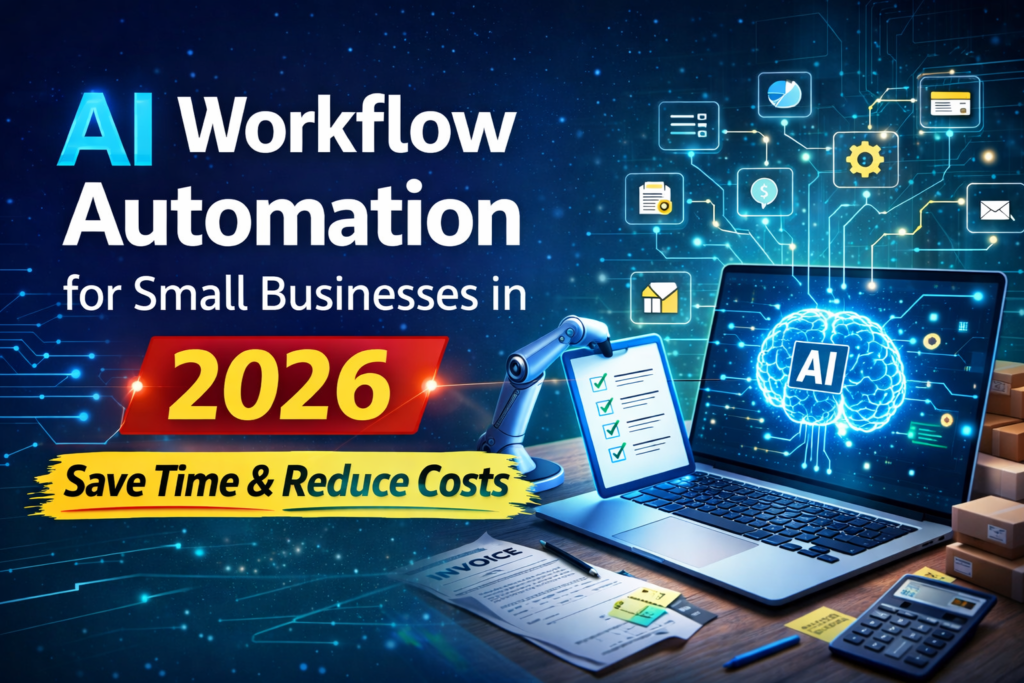
AI workflow automation for small businesses is no longer optional in 2026. It has become a competitive advantage.
Small business owners often handle marketing, sales, support, and operations at the same time. Manual processes slow growth and increase errors.
This guide explains a realistic automation system that helps small businesses save time, reduce operational costs, and scale efficiently without hiring large teams.
What Is AI Workflow Automation?
AI workflow automation means using artificial intelligence tools to:
- Automate repetitive tasks
- Reduce manual data entry
- Improve response time
- Streamline communication
- Organize operations
It is not about replacing employees. It is about improving efficiency.
Why Small Businesses Struggle Without Automation
Common problems include:
- Repetitive email replies
- Manual invoice creation
- Disorganized lead tracking
- Delayed customer responses
- Poor task coordination
These inefficiencies reduce profitability.
AI systems fix structure problems.
Step 1: Automating Customer Communication
Small businesses spend hours answering similar queries.
AI can:
- Auto-generate email responses
- Draft customer follow-ups
- Create FAQ responses
- Assist with support tickets
This reduces response time and improves customer experience.
Step 2: Automating Lead Management
Leads are often lost due to poor tracking.
AI tools help:
- Categorize incoming leads
- Prioritize high-intent prospects
- Draft personalized outreach messages
- Track conversation progress
Automation increases conversion rates.
Step 3: Automating Content and Marketing Tasks
Marketing consumes time.
AI workflow automation for small businesses can:
- Generate blog outlines
- Draft social media captions
- Repurpose content
- Create email campaigns
Consistency improves brand authority.
Step 4: Financial Task Automation
Finance tasks are sensitive but repetitive.
AI systems can:
- Generate invoice drafts
- Summarize expenses
- Track recurring payments
- Analyze spending patterns
This reduces accounting errors.
Step 5: Internal Task Management Automation
AI can:
- Create daily task lists
- Suggest priority adjustments
- Break large projects into steps
- Track deadlines
Productivity increases when tasks are structured.
Real Business Impact of AI Automation
When implemented properly, AI workflow automation for small businesses can:
- Reduce operational workload
- Improve team productivity
- Increase response speed
- Lower labor costs
- Improve decision-making
Automation creates consistency.
Common Mistakes to Avoid
- Automating everything at once
- Using too many tools
- Ignoring data security
- Not monitoring AI outputs
- Over-relying without human review
AI should support processes, not blindly control them.
A Simple Implementation Framework
Layer 1: Communication automation
Layer 2: Lead tracking automation
Layer 3: Marketing automation
Layer 4: Financial task automation
Layer 5: Internal workflow automation
Start small. Scale gradually.
AI workflow automation for small businesses in 2026 is about structure, not shortcuts.
Businesses that implement structured AI systems:
- Save time
- Reduce costs
- Improve efficiency
- Scale sustainably
Automation is not about working less. It is about working smarter.