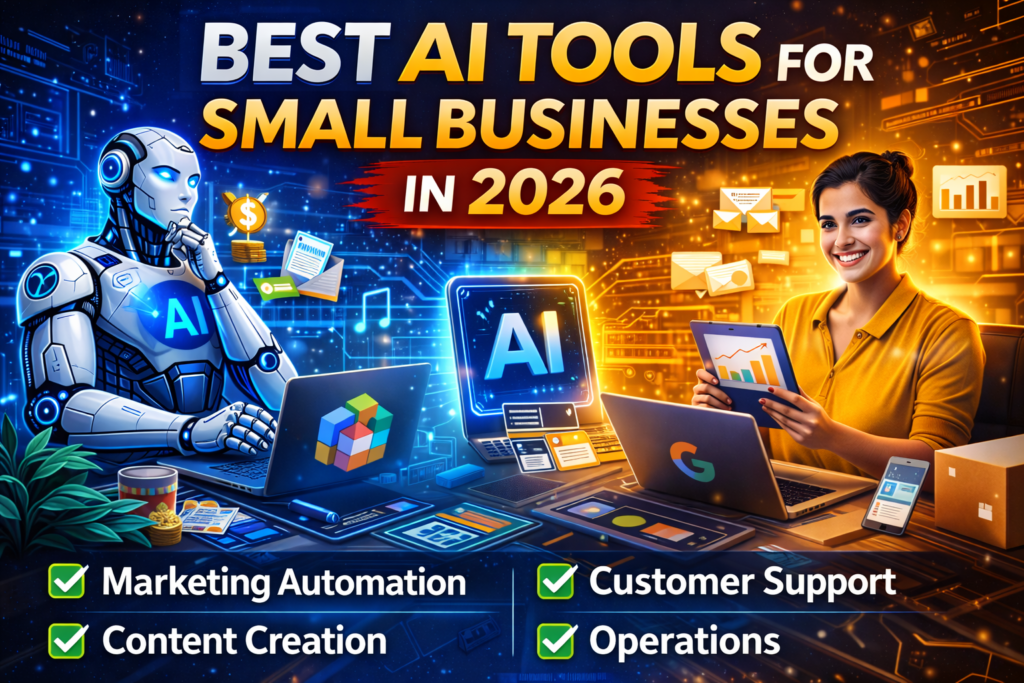
Artificial intelligence is no longer a luxury reserved for large enterprises. In 2026, small businesses are using AI to automate repetitive tasks, improve customer experience, and increase efficiency without hiring large teams.
The real question is not whether AI is useful.
The real question is which AI tools actually make sense for small businesses.
This guide breaks down:
- Practical AI categories that matter
- Real-world use cases
- Limitations to consider
- How to choose the right tool
- Where small businesses often make mistakes
This is not a hype list. It is a practical decision guide.
1. AI Writing and Content Tools
Content marketing remains one of the most cost-effective growth strategies. AI writing tools help small businesses produce blog posts, product descriptions, and email campaigns faster.
One of the most widely used platforms is OpenAI’s ChatGPT.
Use Cases:
- Blog drafting
- Email marketing copy
- FAQ creation
- Product descriptions
- Social media captions
Why It Helps Small Businesses:
- Reduces content production time
- Lowers outsourcing costs
- Enables faster marketing experiments
Limitation:
AI drafts still require human editing. Blind publishing often results in generic content.
2. AI Customer Support Tools
Customer service consumes time and resources. AI chatbots can handle routine inquiries 24/7.
Many small businesses integrate AI into:
- Website chat support
- Order tracking systems
- Appointment scheduling
Modern AI chat tools can:
- Answer frequently asked questions
- Route complex issues to humans
- Reduce response time
Risk to Avoid:
Do not fully automate support for sensitive issues. Hybrid human + AI systems perform better.
3. AI Marketing Automation Platforms
Marketing automation tools now integrate AI for:
- Email personalization
- Audience segmentation
- Predictive analytics
- Campaign optimization
AI can analyze customer behavior and suggest:
- Best sending time
- Content improvements
- High-performing segments
For small teams, this reduces manual data analysis.
4. AI Accounting and Financial Tools
Financial errors are costly. AI-powered accounting platforms help automate:
- Invoice generation
- Expense categorization
- Cash flow forecasting
- Fraud detection
Benefits include:
- Reduced bookkeeping time
- Improved accuracy
- Faster reporting
However, AI should complement, not replace, professional accounting advice.
5. AI Design and Branding Tools
Design often becomes a bottleneck for small businesses. AI design platforms can assist with:
- Logo drafts
- Social media graphics
- Presentation slides
- Marketing banners
These tools are ideal for:
- Early-stage startups
- Budget-conscious entrepreneurs
- Fast iteration marketing
But final branding strategy should remain human-led.
6. AI Data Analysis Tools
Even small businesses generate data:
- Sales data
- Website traffic
- Customer behavior
- Email performance
AI tools can transform raw numbers into actionable insights.
For example:
- Identifying declining products
- Detecting churn risk
- Predicting demand
This gives small businesses enterprise-level analytical capability.
7. AI Workflow Automation Tools
Repetitive tasks reduce productivity. AI workflow tools integrate across apps to automate:
- Lead capture
- CRM updates
- Email follow-ups
- Internal notifications
Automation allows small teams to operate like larger organizations.
How to Choose the Right AI Tool
Before subscribing to any AI platform, ask:
- What problem am I solving?
- Will this tool save measurable time?
- Is it scalable?
- Does it integrate with my current systems?
- What is the long-term cost?
Avoid buying tools simply because they are trending.
Common Mistakes Small Businesses Make
- Adopting too many tools at once
- Ignoring staff training
- Over-automating customer interaction
- Not tracking ROI
- Depending completely on AI without oversight
AI is an accelerator. It is not a replacement for business judgment.
Cost vs Return Consideration
Most AI tools operate on subscription models.
Before investing:
- Estimate monthly usage
- Calculate time saved
- Compare with hiring costs
- Start with one high-impact area
Often, content automation or customer support AI delivers the fastest return.
Future Outlook for Small Businesses
In the coming years:
- AI integration will become standard
- Customers will expect faster response times
- Data-driven decisions will dominate
Small businesses that adopt AI thoughtfully will compete more effectively with larger firms.
The key is strategic implementation, not blind adoption.
The best AI tools for small businesses are not necessarily the most advanced ones. They are the tools that solve specific operational bottlenecks.
Start small. Test carefully. Measure impact. Scale gradually.
AI works best when it enhances human decision-making rather than replacing it. Small businesses that understand this balance will gain efficiency without losing authenticity.