
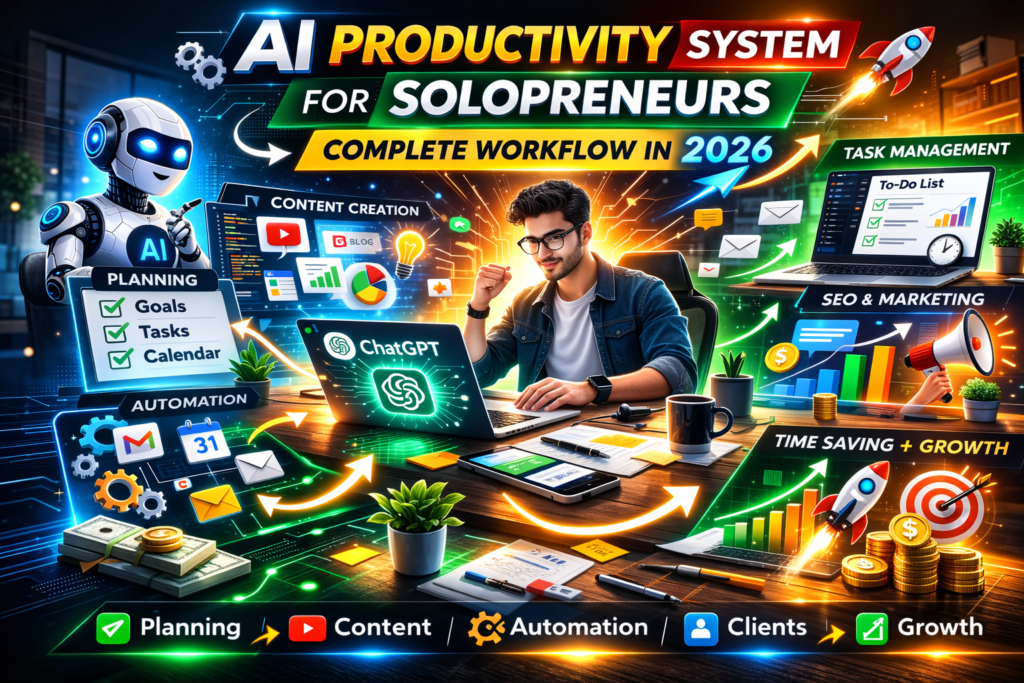
Running a business alone is demanding. As a solopreneur, you handle marketing, content, customer support, operations, and strategy. Time becomes your most limited resource.
In 2026, the biggest advantage is not working more hours. It is building a structured AI productivity system.
This guide explains:
- How to design a daily AI workflow
- Where ChatGPT fits into task management
- How automation tools reduce repetitive work
- How to avoid AI overload
- A practical, repeatable productivity framework
This is not about random tools. It is about system design.
1. Why Solopreneurs Need an AI Productivity System
Solopreneurs often struggle with:
- Context switching
- Decision fatigue
- Task overload
- Inconsistent execution
AI helps reduce cognitive load.
Instead of thinking through everything manually, you can use structured prompts and automation flows to:
- Plan
- Draft
- Organize
- Analyze
The goal is clarity, not chaos.
2. Core Pillars of an AI Productivity System
A strong system for solopreneurs usually has four pillars:
- Planning
- Creation
- Automation
- Review
Each pillar can be enhanced using AI tools.
3. Planning with AI
Start your week with structured planning.
Using ChatGPT from OpenAI, you can generate:
- Weekly goal breakdowns
- Content calendars
- Task prioritization lists
- Focus blocks
Example structured prompt:
“Act as a productivity strategist. Break down my goal of launching a digital product in 30 days into weekly and daily tasks. Keep it realistic for a solopreneur.”
This helps convert abstract goals into clear execution steps.
4. Content Creation Workflow
If you are building a brand, content is essential.
AI can assist with:
- Blog outlines
- YouTube scripts
- Email drafts
- Social media posts
Recommended workflow:
- Generate outline
- Draft section by section
- Manually refine
- Optimize for SEO
- Repurpose into multiple formats
AI speeds up drafting. You maintain quality control.
5. Client and Communication Management
Solopreneurs often lose time writing repetitive emails.
AI can help with:
- Proposal drafts
- Follow-up messages
- Onboarding documents
- FAQ responses
Instead of writing from scratch each time, create template prompts that generate customized responses quickly.
This reduces administrative fatigue.
6. Task Automation Layer
Automation tools integrate across platforms to reduce manual work.
Examples of tasks to automate:
- Lead capture to CRM
- Email follow-up sequences
- Invoice reminders
- Meeting scheduling
AI enhances these workflows by:
- Generating response content
- Categorizing leads
- Summarizing meeting notes
The key is connecting tools, not using them in isolation.
7. Daily AI Routine Example
Here is a sample daily system:
Morning:
- Use AI to prioritize top 3 tasks
- Generate quick planning notes
Midday:
- Draft content using structured prompts
- Automate client responses
Evening:
- Summarize completed tasks
- Generate next-day focus plan
This prevents reactive work patterns.
8. Avoiding AI Overdependence
While AI improves productivity, overuse can reduce clarity.
Avoid:
- Constantly regenerating plans
- Changing strategy daily
- Automating sensitive decisions
- Relying on AI without verification
Use AI for structure and speed, not final judgment.
9. Measuring Productivity Gains
AI should create measurable improvements.
Track:
- Hours saved per week
- Content output increase
- Client response time
- Revenue growth linked to automation
Without measurement, productivity gains remain assumptions.
10. Long-Term Benefits for Solopreneurs
A structured AI productivity system leads to:
- Reduced burnout
- Clearer decision-making
- Consistent content output
- Scalable operations
- More time for strategy
Instead of feeling overwhelmed, you operate with intention.
AI productivity is not about using every tool available. It is about building a repeatable system that reduces friction in your daily operations.
For solopreneurs, the real advantage in 2026 is structured leverage. When AI handles drafting, organizing, and repetitive communication, you gain time to focus on growth and innovation.
Start simple. Build one workflow at a time. Refine gradually. Over time, your AI productivity system becomes a competitive edge.