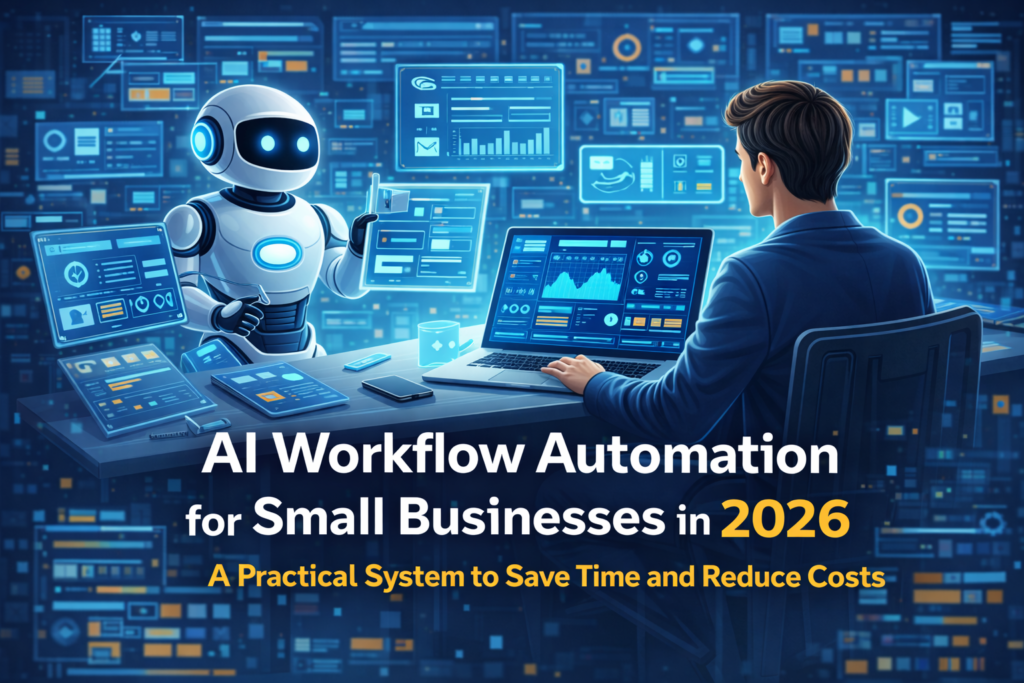
Small businesses often struggle with limited time, small teams, and increasing workloads. Many business owners spend hours handling repetitive tasks such as emails, customer inquiries, marketing, and data management.
AI workflow automation is solving this problem in 2026.
By using AI-powered automation tools, businesses can automate daily operations, improve efficiency, and focus on growth instead of routine tasks.
What is AI Workflow Automation?
AI workflow automation means using artificial intelligence to automate repetitive business processes.
Instead of performing tasks manually, AI tools can automatically complete them based on rules or triggers.
Examples include:
- sending automated emails
- managing customer support responses
- generating marketing content
- organizing tasks and workflows
- analyzing business data
Automation allows businesses to operate more efficiently.
Why Small Businesses Need AI Automation
Small businesses benefit greatly from AI automation because it reduces workload while increasing productivity.
Key benefits include:
Save Time
AI tools handle repetitive tasks automatically, allowing business owners to focus on strategy and growth.
Reduce Costs
Automation reduces the need for large teams, helping businesses save operational costs.
Improve Productivity
Employees can focus on high-value tasks instead of routine work.
Scale Faster
Automation allows businesses to handle more customers and operations without increasing staff.
AI Workflows That Small Businesses Can Automate
Many business processes can now be automated using AI tools.
Customer Support Automation
AI chatbots can answer customer questions instantly.
They can:
- respond to FAQs
- handle support tickets
- guide customers through products
This improves customer experience and reduces support workload.
Email Marketing Automation
AI email tools can automatically send personalized marketing emails.
Businesses can automate:
- welcome emails
- promotional campaigns
- follow-up messages
- customer engagement emails
This increases marketing efficiency.
Content Creation Automation
AI writing tools can generate blog posts, social media content, and marketing copy quickly.
Businesses can use AI to:
- create blog content
- generate product descriptions
- write marketing emails
- plan content strategies
This helps maintain consistent content marketing.
Sales Funnel Automation
AI tools can automate lead management and sales pipelines.
They can:
- capture leads from forms
- send follow-up emails
- schedule appointments
- track customer interactions
Automation improves sales performance.
Data Analysis and Reporting
AI analytics tools help businesses understand performance and make better decisions.
They can analyze:
- website traffic
- customer behavior
- marketing campaign results
- sales performance
This helps businesses improve strategies.
Best AI Tools for Workflow Automation
Several AI tools help automate business workflows.
Popular options include:
Zapier
Zapier connects multiple apps and automates tasks between them.
For example:
- new lead → add to CRM
- form submission → send email
- new sale → update spreadsheet
Notion AI
Notion AI helps manage tasks, documents, and workflows in one place.
Businesses use it for:
- project management
- team collaboration
- knowledge management
ChatGPT
AI assistants help generate content, answer questions, and automate communication tasks.
Businesses use them for:
- customer support
- content creation
- brainstorming ideas
Make (Automation Platform)
Make allows businesses to build complex automation workflows without coding.
It integrates with hundreds of apps and services.
How Small Businesses Can Start Using AI Automation
Implementing AI automation does not need to be complicated.
A simple strategy is:
Step 1
Identify repetitive tasks that consume time.
Step 2
Choose AI tools that automate those tasks.
Step 3
Start with small workflows and expand gradually.
Step 4
Monitor results and optimize automation systems.
This approach ensures smooth implementation.
The Future of AI Automation for Businesses
AI automation will continue evolving in the coming years.
Experts believe that businesses will increasingly rely on AI assistants to manage daily operations.
Companies that adopt AI automation early will gain a competitive advantage by operating faster and more efficiently.
AI workflow automation is transforming how small businesses operate in 2026.
By automating repetitive tasks, businesses can save time, reduce costs, and focus on growth strategies.
Small businesses that start using AI automation today will build more efficient systems and stay competitive in the future.