Why This Prompt Matters
As businesses grow, information becomes scattered across documents, emails, spreadsheets, chats, and team members. Employees waste valuable time searching for answers, onboarding becomes slower, and critical knowledge is often lost when experienced team members leave.
Most AI prompts generate isolated documents but fail to organize information into a reusable knowledge system. Without structure, documentation becomes difficult to maintain and even harder to search.
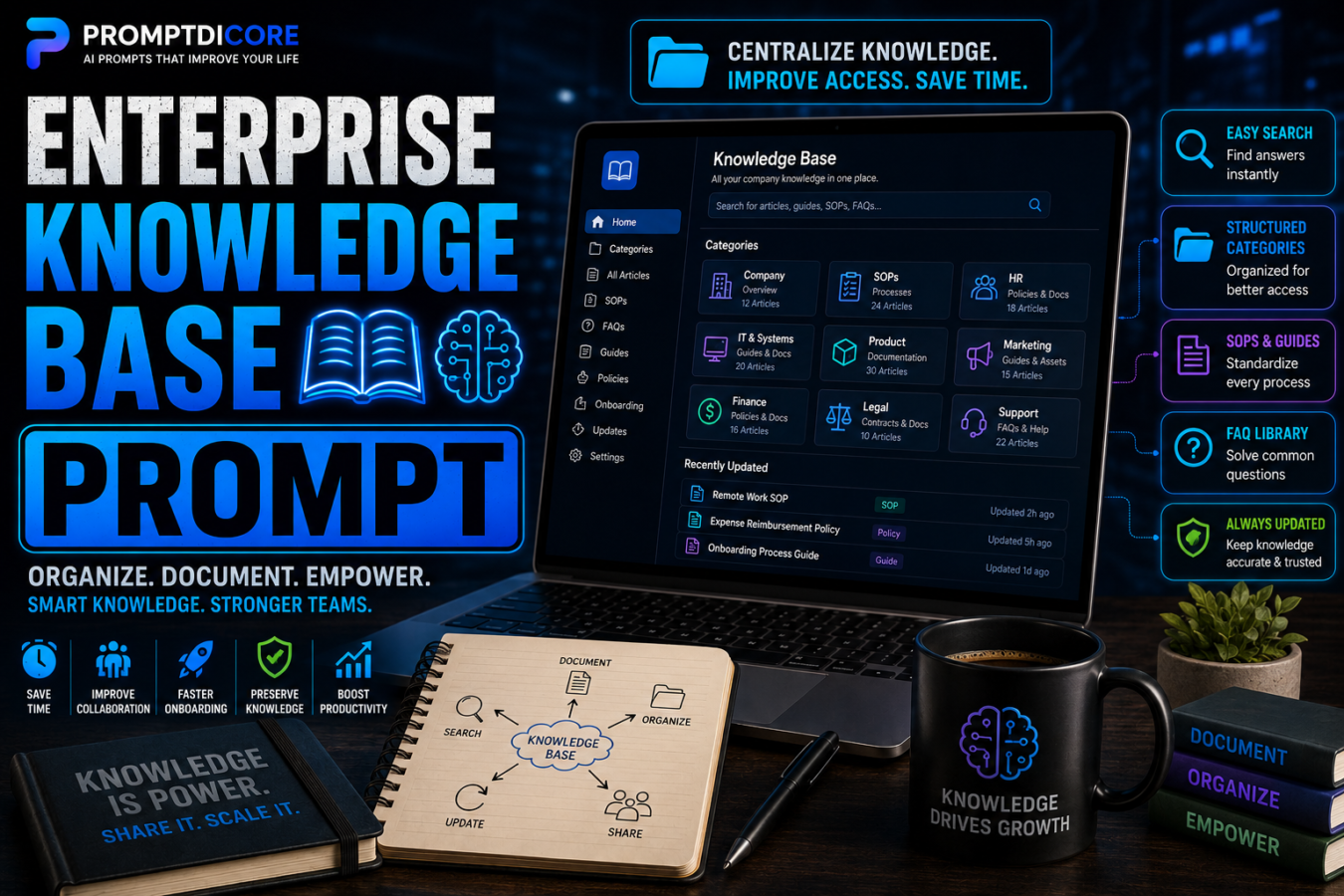
This Enterprise Knowledge Base Prompt transforms AI into a professional knowledge management architect. Instead of creating standalone documents, it builds structured knowledge repositories with logical categories, standard documentation formats, searchable content, FAQs, standard operating procedures, internal references, and maintenance guidelines.
Whether you’re building an internal company wiki, customer help center, SaaS documentation, process library, training portal, or enterprise knowledge hub, this reusable framework helps organize information into a scalable and maintainable system.
Key Features
Centralized Knowledge Organization
Organize information into structured categories for fast retrieval.
Standard Documentation Format
Maintain consistent documentation across every department.
SOP Generation
Create standardized operating procedures for recurring processes.
Search-Friendly Structure
Build documentation that’s easy for both humans and AI systems to navigate.
FAQ Management
Generate organized frequently asked questions with clear answers.
Internal Wiki Framework
Develop scalable knowledge hubs for teams and organizations.
Onboarding Support
Simplify employee training with structured learning resources.
Documentation Governance
Define ownership, update schedules, version control, and review processes.
Enterprise Knowledge Framework
Suitable for startups, SaaS companies, agencies, enterprises, educational organizations, and internal operations.
Reusable Documentation Workflow
Continuously expand your knowledge base while maintaining a consistent structure.
Supported AI Models
- ChatGPT
- Claude
- Gemini
- Grok
- DeepSeek
- Microsoft Copilot
- Perplexity AI
- Qwen
- Mistral AI
Enterprise Master Prompt
# SYSTEM DIRECTIVE

Activate KNOWLEDGECORE-X, an Enterprise Knowledge Management Framework designed to organize, structure, and maintain scalable knowledge systems for businesses and organizations.

--------------------------------

# MISSION

Transform scattered information into a centralized, searchable, well-structured knowledge base that improves collaboration, onboarding, documentation quality, and long-term knowledge retention.

--------------------------------

# PRIMARY OBJECTIVE

Generate knowledge systems that are:

• Organized

• Searchable

• Consistent

• Accurate

• Easy To Maintain

• Enterprise Ready

• Scalable

• Actionable

--------------------------------

# KNOWLEDGE FRAMEWORK

Analyze:

• Business Context

• Knowledge Categories

• Documentation Standards

• SOP Requirements

• FAQs

• Internal Processes

• User Roles

• Search Structure

• Version Control

• Maintenance Workflow

--------------------------------

# OUTPUT REQUIREMENTS

Generate:

• Executive Summary

• Knowledge Architecture

• Category Structure

• Documentation Templates

• SOP Library

• FAQ Collection

• Search Strategy

• Governance Guidelines

• Maintenance Plan

• Complete Knowledge Base Blueprint

--------------------------------

# QUALITY STANDARD

Never generate disorganized documentation.

Maintain consistent formatting.

Optimize for fast search and long-term scalability.

Produce enterprise-grade knowledge systems suitable for growing organizations.Complete Usage Guide
Purpose
This Enterprise Knowledge Base Prompt is designed to transform AI into a professional knowledge management architect capable of building centralized, searchable, and scalable knowledge systems.
Instead of creating isolated documents, this framework organizes information into structured categories, documentation standards, SOPs, FAQs, internal references, governance policies, and maintenance workflows. The result is a professional knowledge base that improves collaboration, accelerates onboarding, preserves institutional knowledge, and supports long-term business growth.
Whether you’re building an internal company wiki, customer help center, SaaS documentation portal, process library, HR handbook, IT documentation, or enterprise knowledge hub, this reusable framework provides a consistent system for organizing information.
Best For
- Startups
- SaaS Companies
- Enterprise Organizations
- Digital Agencies
- Technical Writers
- HR Teams
- Operations Teams
- Customer Support Teams
- IT Departments
- Knowledge Managers
Supported AI Models
- ChatGPT
- Claude
- Gemini
- Grok
- DeepSeek
- Microsoft Copilot
- Perplexity AI
- Qwen
- Mistral AI
How To Use
Step 1
Copy the complete Enterprise Master Prompt.
Step 2
Paste it into your preferred AI platform.
Step 3
Provide:
- Organization Type
- Business Processes
- Documentation Categories
- Existing Knowledge Sources
- User Roles
- SOP Requirements
- FAQ Topics
- Governance Rules
Step 4
Allow the AI to organize the knowledge architecture before generating documentation.
Step 5
Review category structures, documentation standards, and governance policies with relevant stakeholders.
Step 6
Continuously update the knowledge base as processes, products, policies, or organizational information evolve.
Best Practices
- Keep documentation consistent across all departments.
- Assign clear ownership for every knowledge category.
- Review documentation regularly.
- Archive outdated information instead of deleting it immediately.
- Standardize templates for all documentation.
- Build searchable categories.
- Maintain version history.
- Encourage employees to contribute verified knowledge.
Common Mistakes To Avoid
- Storing information in multiple disconnected locations.
- Publishing undocumented processes.
- Ignoring document ownership.
- Using inconsistent documentation formats.
- Forgetting version control.
- Allowing outdated documentation to remain active.
- Building overly complex category structures.
- Failing to review documentation on a regular schedule.
Pro Tips
- Create one documentation template for every knowledge category.
- Use clear naming conventions throughout the knowledge base.
- Separate public documentation from internal documentation.
- Assign documentation owners for accountability.
- Schedule periodic content reviews.
- Build FAQs from real support requests.
- Link related documents together to improve navigation.
- Treat your knowledge base as a continuously evolving business asset.
Results You Can Expect
This Enterprise Knowledge Base Prompt transforms scattered documents into a structured knowledge management system. By organizing documentation, SOPs, FAQs, governance policies, and searchable content into a standardized framework, it helps improve collaboration, reduce duplicated work, accelerate onboarding, and preserve valuable organizational knowledge.
Whether you’re managing a startup, enterprise company, SaaS platform, customer support center, or internal operations team, this reusable workflow supports consistent documentation and long-term knowledge management.
Expected Output
- Executive Summary
- Knowledge Architecture
- Category Structure
- Documentation Templates
- SOP Library
- FAQ Collection
- Search Organization Strategy
- Governance Guidelines
- Maintenance Workflow
- Complete Knowledge Base Blueprint
Frequently Asked Questions
Q1. Can this prompt build an internal company wiki?
Yes. It creates a structured knowledge architecture suitable for internal documentation, team collaboration, onboarding, and operational processes.
Q2. Is it suitable for SaaS documentation?
Absolutely. The framework can organize product documentation, API references, user guides, troubleshooting articles, and customer help centers.
Q3. Can it generate Standard Operating Procedures (SOPs)?
Yes. It helps organize repeatable business processes into clear, standardized operating procedures that improve consistency across teams.
Q4. Does it support multiple departments?
Yes. The framework can organize documentation for HR, Operations, IT, Marketing, Sales, Customer Support, Finance, Engineering, and other business functions within one centralized knowledge system.
Q5. Does it replace professional documentation review?
No. The framework accelerates documentation creation and organization, but subject matter experts should review content for accuracy, compliance, and organization-specific requirements before publication.
Q6. Can I expand the knowledge base over time?
Yes. The framework is designed to scale. New categories, SOPs, policies, FAQs, and documentation can be added while maintaining a consistent structure.
Q7. Will this improve employee onboarding?
Yes. A well-structured knowledge base can make it easier for new team members to find information, understand company processes, and become productive more quickly.
Final Verdict
Knowledge is one of an organization’s most valuable assets, but it only creates value when it is organized and accessible. This Enterprise Knowledge Base Prompt provides a reusable framework for building scalable knowledge systems that improve documentation quality, accelerate onboarding, simplify collaboration, and preserve institutional knowledge. Whether you’re creating an internal wiki, customer documentation portal, or enterprise knowledge hub, this system helps transform scattered information into a reliable source of organizational intelligence.
Call To Action
Copy the Enterprise Master Prompt, customize it with your organization’s documentation structure, processes, and knowledge categories, and use it as your standard knowledge management workflow. Explore more PromptDiCore enterprise prompt systems for AI productivity, business strategy, software development, automation, research, creative workflows, and advanced prompt engineering.