One of the easiest ways to make a decision harder to evaluate is to become attached to the conclusion before examining the evidence.
You decide that a project should launch.
You believe a particular strategy is the right one.
You think a purchase is worth the money.
You become convinced that a particular explanation is correct.
From that point forward, new information can quietly become a search for confirmation rather than an honest test of the decision.
There is a simple way to interrupt that pattern:
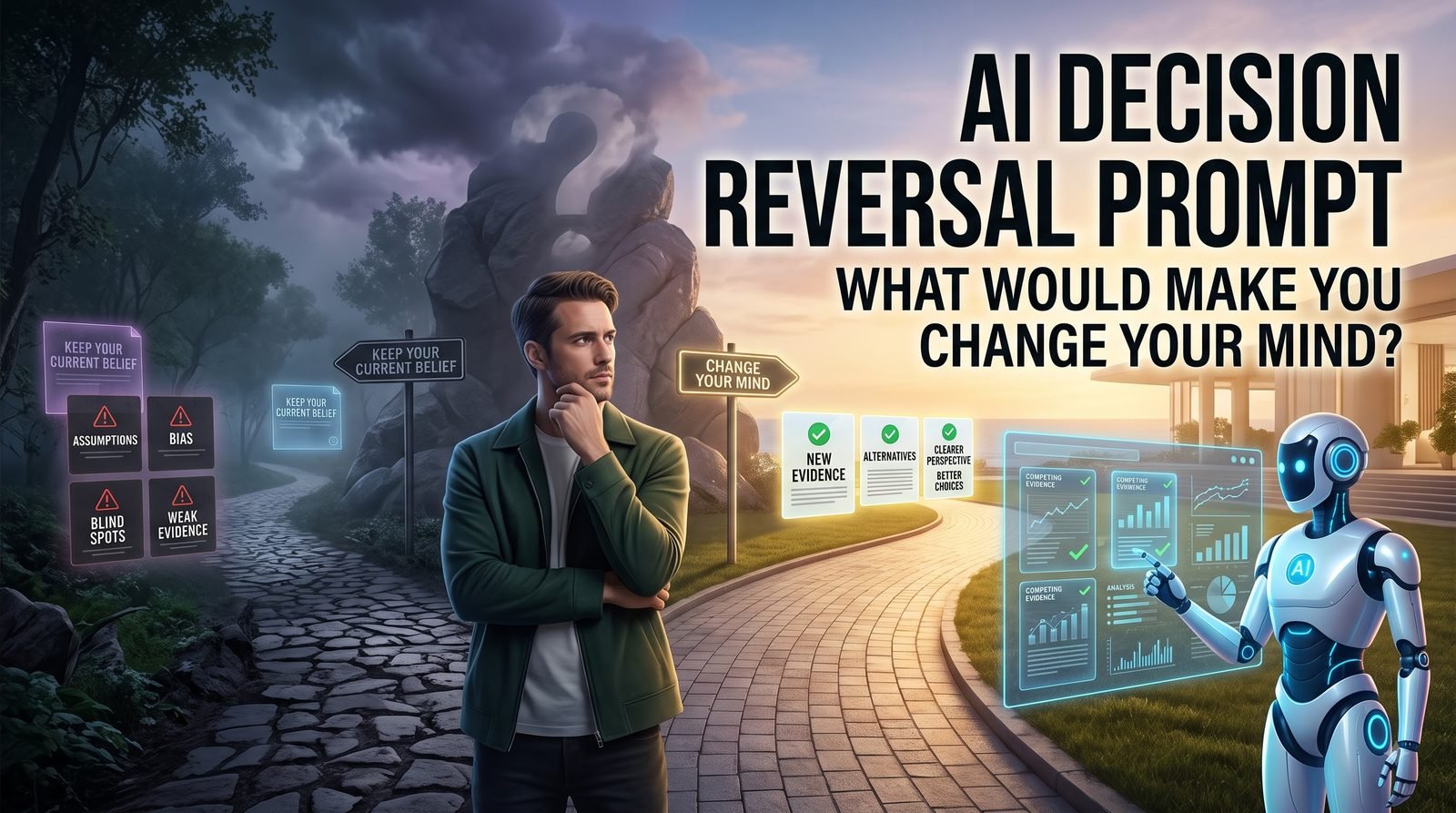
Ask what would make you change your mind.
This prompt turns that question into a structured reasoning exercise.
A Strong Position Should Have a Breaking Point
Suppose you believe:
“We should launch the product this month.”
That statement becomes more useful when you can also explain:
“I would reconsider if testing showed that demand is substantially lower than expected.”
Now your position has a condition.
You are not saying the decision is certainly correct.
You are saying what evidence would cause you to reassess it.
That creates a more flexible decision process.
Why This Is Different From Asking AI to Criticize You
A normal critique might search for weaknesses in your argument.
That can be useful, but it may still leave you defending your original position.
The decision-reversal approach asks a more specific question:
What information would be strong enough to actually change the conclusion?
That forces the analysis to distinguish between minor objections and genuinely decision-changing evidence.
Start With Your Current Position
The prompt works best when you clearly state what you currently believe.
For example:
“I believe I should leave my current role and start freelancing.”
Then provide the reasoning:
“I have strong skills, several potential clients, and I want more independence.”
Now the AI can examine the reasoning and identify what your conclusion depends on.
Perhaps your decision depends heavily on assumptions about client demand, income stability, savings, or your ability to acquire work consistently.
Those become the areas worth testing.
Not All Evidence Deserves Equal Weight
Imagine you believe a new product will sell well.
Someone tells you:
“I don’t think people will like it.”
That is a contrary opinion.
It may be worth hearing, but it is not necessarily strong evidence.
Now imagine several actual customers repeatedly decline to purchase after seeing the offer.
That could be much more significant.
The prompt therefore asks AI to distinguish between:
Opinions
Weak objections
Relevant evidence
Strong disconfirming evidence
This makes the analysis more disciplined.
Find the Assumptions Holding the Decision Together
Every major decision depends on something.
Maybe you are assuming:
- Customers will respond to the offer
- A deadline is achievable
- A particular cost estimate is accurate
- A strategy will produce enough demand
- A skill can be learned within a certain period
- An alternative option is actually worse
If one of those assumptions changes, the decision may change too.
The prompt identifies those dependencies so you know where to pay attention.
Use It Against Decisions You Already Like
This is where the workflow becomes particularly useful.
People naturally look for supporting information when they want something to be true.
If you are excited about a business idea, you may focus on positive signals.
If you want to buy something, you may emphasize its benefits.
If you want to accept a new opportunity, you may minimize the risks.
The decision-reversal prompt deliberately creates space for information that could challenge the preferred conclusion.
That does not mean automatically rejecting the idea.
It means giving the contrary case a fair hearing.
A Simple Example
Imagine you are considering switching to a new software platform.
Your current position:
“The new platform is better because it has more features.”
The prompt may uncover a deeper issue.
Perhaps the real decision depends on:
- Whether those features are actually needed
- Migration effort
- Training time
- Compatibility
- Reliability
- Total cost
- Whether the team will actually use the additional capabilities
Now the question changes from:
“Does the new platform have more features?”
to:
“What evidence would demonstrate that those additional features create enough practical value to justify the change?”
That is a much better decision question.
Make Your Reversal Conditions Specific
Weak reversal condition:
“If something goes wrong.”
Strong reversal condition:
“If the pilot shows that the new workflow takes longer than the current process without producing a meaningful improvement in output quality.”
The second condition can actually be tested.
That is what makes it useful.
Use It Before You Commit
This prompt is particularly valuable before decisions that are difficult or expensive to reverse.
Examples include:
- Major purchases
- Business investments
- Product launches
- Hiring decisions
- Career changes
- Long-term projects
- Strategic changes
- Technology migrations
- Major commitments
You can run the analysis before the decision and keep the reversal conditions as checkpoints.
That turns uncertainty into something you can monitor.
MASTER PROMPT — COPY & PASTE
Act as a decision analyst focused on disconfirming evidence and intellectual rigor.

CURRENT DECISION:
[Describe the decision]

MY CURRENT POSITION:
[State what I currently believe or intend to do]

MY REASONING:
[Explain why I currently hold this position]

AVAILABLE EVIDENCE:
[Provide relevant facts, observations, data, feedback, or constraints]

ALTERNATIVES:
[Describe the main alternatives, if known]

Analyze my decision without automatically agreeing with or rejecting my position.

Produce:

1. CURRENT CASE
Summarize the strongest reasons supporting my current position.

2. KEY ASSUMPTIONS
Identify the assumptions my decision depends on.

3. VULNERABLE ASSUMPTIONS
Identify which assumptions are uncertain or particularly important to the outcome.

4. STRONGEST COUNTERCASE
Construct the strongest reasonable argument against my current position.

5. DECISION-CHANGING EVIDENCE
Identify the specific evidence that would be strong enough to materially weaken or reverse my current position.

6. REVERSAL CONDITIONS
Create clear, observable conditions under which I should reconsider the decision.

7. EVIDENCE WEIGHT
Separate weak objections, meaningful concerns, and strong disconfirming evidence.

8. INFORMATION GAPS
Identify what I would need to know before making a high-confidence decision.

9. BIAS CHECK
Identify possible confirmation bias, sunk-cost thinking, motivated reasoning, or other cognitive biases that may affect my evaluation.

10. TESTS
Suggest practical ways to test the most important assumptions before making an irreversible commitment.

11. DECISION RULE
Create a simple rule explaining when I should continue with the current position and when I should reconsider it.

12. FINAL ASSESSMENT
Explain whether my current position appears well-supported, uncertain, or heavily dependent on unverified assumptions.

Rules:
- Do not invent evidence.
- Do not treat disagreement as proof that my position is wrong.
- Do not manufacture artificial counterarguments.
- Clearly distinguish facts, assumptions, opinions, and unknowns.
- Give greater weight to evidence that could genuinely change the decision.
- Do not force a reversal when the evidence does not justify one.
- If the available information is insufficient, say so clearly.
Use a Decision Rule Instead of Constant Doubt
The purpose of this exercise is not to make you question every decision forever.
That would create another problem.
You need a stopping point.
For example:
“If the pilot meets the agreed success criteria and no major technical issue appears, proceed with the launch.”
Now you have a predefined rule.
You do not need to reconsider the entire decision every time someone expresses a different opinion.
You only need to revisit it when meaningful evidence crosses the threshold you established.
Revisit the Decision When Reality Changes
A decision can be reasonable when made and still become unreasonable later.
New information may change:
- Costs
- Demand
- Timing
- Resources
- Risks
- Customer behavior
- Technical feasibility
- Available alternatives
That does not mean the original decision was necessarily bad.
It means the decision was based on the information available at that time.
The reversal framework gives you a structured way to update your position when important conditions change.
The Goal Is Not to “Win” the Argument
A useful decision process should allow you to discover that you were wrong without treating that as failure.
If strong evidence changes your mind, the process worked.
If strong evidence fails to change your mind because the original reasoning remains well supported, the process also worked.
The important part is that you know why you are maintaining or changing your position.
That is the real value of asking:
“What would make me change my mind?”