AI Meeting Question Generator Prompt: Ask Better Questions Before Making a Decision
A meeting can give you plenty of information and still leave you unprepared to make a good decision.
The missing piece is often not another answer.
It is a better question.
Consider a simple proposal:
“We should launch this product next month.”
You could immediately ask whether everyone agrees.
But that may not be the most useful question.
A stronger set of questions might be:
- What evidence supports the launch date?
- What could prevent us from being ready?
- What assumptions are we making about demand?
- What would make us delay the launch?
- Which information would change our decision?
Those questions expose the structure behind the proposal.
That is what this prompt is built to do.
Why Better Questions Matter
Questions determine what information enters a discussion.
If you ask shallow questions, you often get shallow answers.
For example:
“Do you think this will work?”
produces opinions.
Compare that with:
“What evidence would make us more confident that this will work?”
Now the conversation moves toward evidence.
The difference is small in wording but significant in reasoning.
What This Prompt Looks For
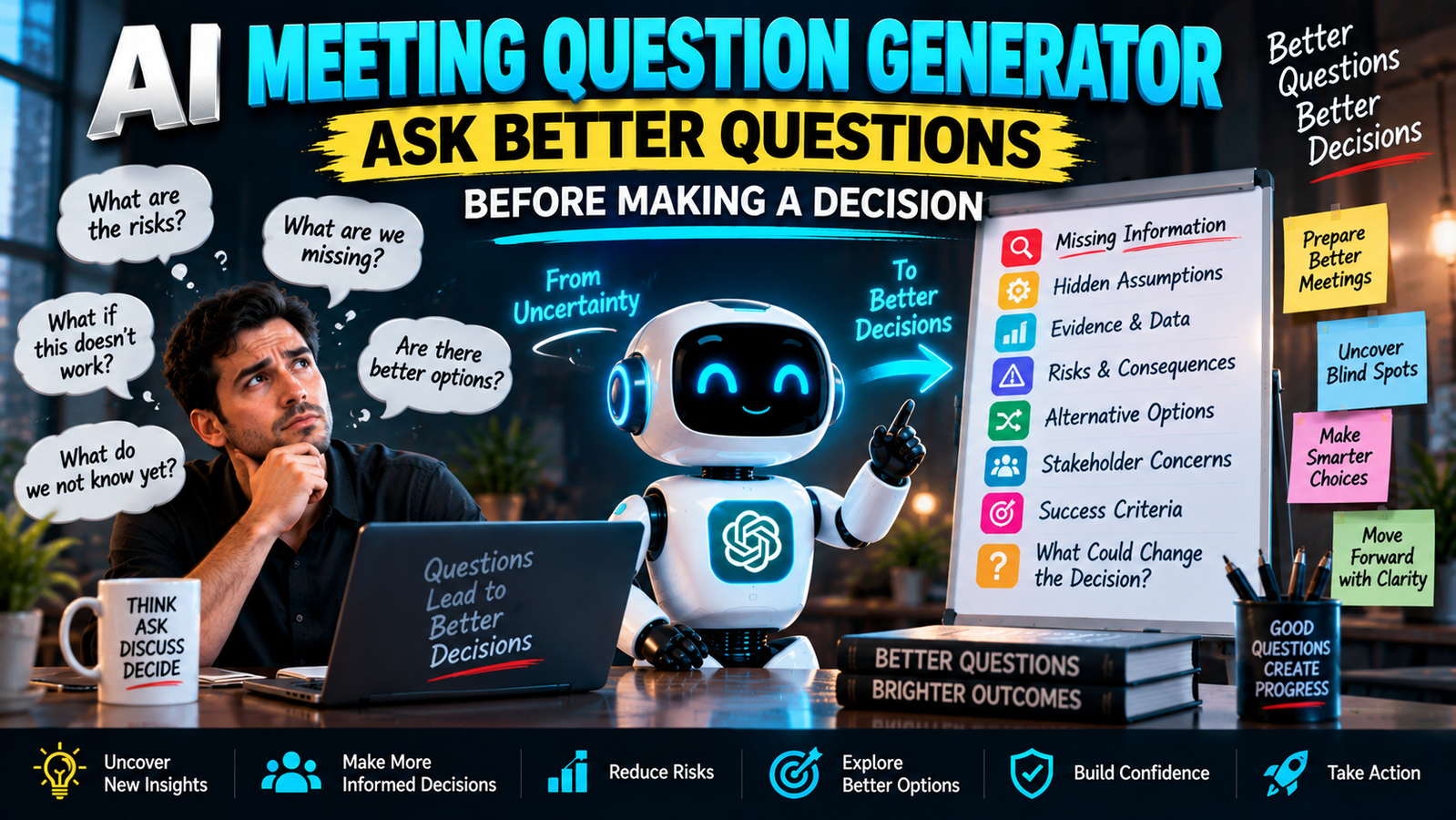
The prompt analyzes a topic, proposal, plan, or decision and generates questions across several dimensions.
It looks for questions about:
- Missing information
- Hidden assumptions
- Evidence
- Risks
- Alternatives
- Constraints
- Costs and benefits
- Dependencies
- Consequences
- Stakeholder concerns
- Success criteria
- Conditions that could change the decision
The goal is not to create a huge list of questions.
It is to identify the questions most likely to improve the quality of the discussion.
Use It Before an Important Meeting
This is where the prompt becomes especially practical.
Suppose you have a meeting tomorrow about changing your company’s pricing.
Instead of entering the meeting with only a general understanding of the proposal, give the AI the available context.
It can help you identify questions such as:
Evidence: What customer behavior supports the proposed change?
Risk: Which customers are most likely to react negatively?
Alternative: What happens if we change packaging instead of price?
Measurement: How will we know whether the new pricing worked?
Reversibility: If the change performs poorly, how easily can we reverse it?
Now you are entering the meeting prepared to investigate the decision rather than simply react to it.
Questions Can Reveal Hidden Assumptions
One of the strongest uses of this workflow is assumption discovery.
People frequently make assumptions without realizing they are doing so.
For example:
“Customers will upgrade because the new version has more features.”
That statement contains several assumptions.
Perhaps customers value those features.
Perhaps they understand them.
Perhaps the additional value is worth the higher price.
Perhaps the upgrade process is easy enough.
A good question can expose these assumptions before they become expensive mistakes.
It Is Also Useful for Personal Decisions
You do not need a team or formal meeting to use this prompt.
Imagine you are considering:
- Changing jobs
- Starting a side project
- Buying expensive equipment
- Moving to a new city
- Learning a new skill
- Changing your business strategy
You can provide your current reasoning and ask AI to challenge it with useful questions.
This is different from asking AI:
“Should I do this?”
Instead, you are asking:
“What should I think about before deciding?”
That keeps the decision in your hands while making the thinking process more thorough.
Avoid Asking Every Question
More questions do not automatically mean better analysis.
A list of 50 questions can become another form of noise.
The prompt therefore asks AI to prioritize the questions.
The strongest questions should be the ones where the answer could materially change your understanding, strategy, or decision.
That makes the output easier to use in a real conversation.
Give the AI Context
The more context you provide, the more specific the questions can become.
Instead of:
“Generate questions about launching a product.”
Try:
“We are considering launching a new productivity app for freelancers. The product is ready, but we have limited marketing budget and no existing audience.”
Now the AI can generate questions around acquisition, positioning, launch timing, budget constraints, validation, and alternatives.
The objective is not to make the prompt complicated.
It is to give the model enough information to reason about the actual situation.
MASTER PROMPT — COPY & PASTE
Act as a strategic question designer and critical-thinking advisor.

I will provide a topic, proposal, plan, problem, or decision.

TOPIC / DECISION:
[Enter the topic]

CONTEXT:
[Provide relevant background, goals, constraints, evidence, and concerns]

OBJECTIVE:
[What I need to decide, understand, evaluate, or discuss]

Generate high-value questions that could improve the quality of the discussion or decision.

Look specifically for questions about:

1. Missing information
2. Hidden assumptions
3. Evidence and supporting data
4. Risks and unintended consequences
5. Alternatives
6. Constraints and dependencies
7. Costs, benefits, and trade-offs
8. Stakeholder concerns
9. Success criteria
10. What could change the decision

For each important question, explain briefly:
- Why the question matters
- What kind of information it could reveal
- Whether answering it could materially change the decision

Then:

- Remove repetitive or low-value questions.
- Group similar questions together.
- Rank the 10 most important questions from highest to lowest priority.
- Identify the 3 questions that should be asked first.
- Add 3 challenging questions that a thoughtful skeptic might ask.
- Identify any major issue that cannot be evaluated because the provided information is insufficient.

Rules:
- Do not assume missing facts.
- Do not answer the questions unless useful for explaining their purpose.
- Do not create questions merely to increase the list size.
- Prefer specific, decision-relevant questions over generic questions.
- Challenge weak assumptions respectfully.
- Prioritize questions whose answers could meaningfully improve the decision.
A Useful Way to Organize the Output
Once you have the questions, you do not need to ask them all at once.
Start with the three highest-priority questions.
Then use the answers to determine what needs to be explored next.
For example:
Question 1: What evidence supports the proposal?
If the evidence is weak, there may be no reason to move directly to implementation.
If the evidence is strong, you can move to the next question:
Question 2: What could prevent the expected result?
That naturally leads toward risk analysis.
The conversation becomes a sequence rather than a random collection of questions.
Turn the Prompt Into a Pre-Decision Checklist
You can also use the generated questions after the meeting.
Take the questions that were not answered and turn them into a short follow-up checklist.
This gives you a simple workflow:
Proposal → Better Questions → Discussion → Missing Answers → Decision
That is often more useful than generating a summary after everything is finished.
A summary tells you what happened.
Good questions can help determine what should happen next.
The Question That Changes the Conversation
Before an important decision, ask yourself one simple thing:
“What answer would actually change my mind?”
That question is powerful because it forces you to identify the information that matters most.
If nothing could change your position, you may already be defending a conclusion rather than evaluating it.
If several answers could change your position, those are exactly the areas worth investigating.
Use the prompt to find those questions before the decision becomes difficult to reverse.
The objective is not to question everything.
It is to make sure you are questioning the right things.