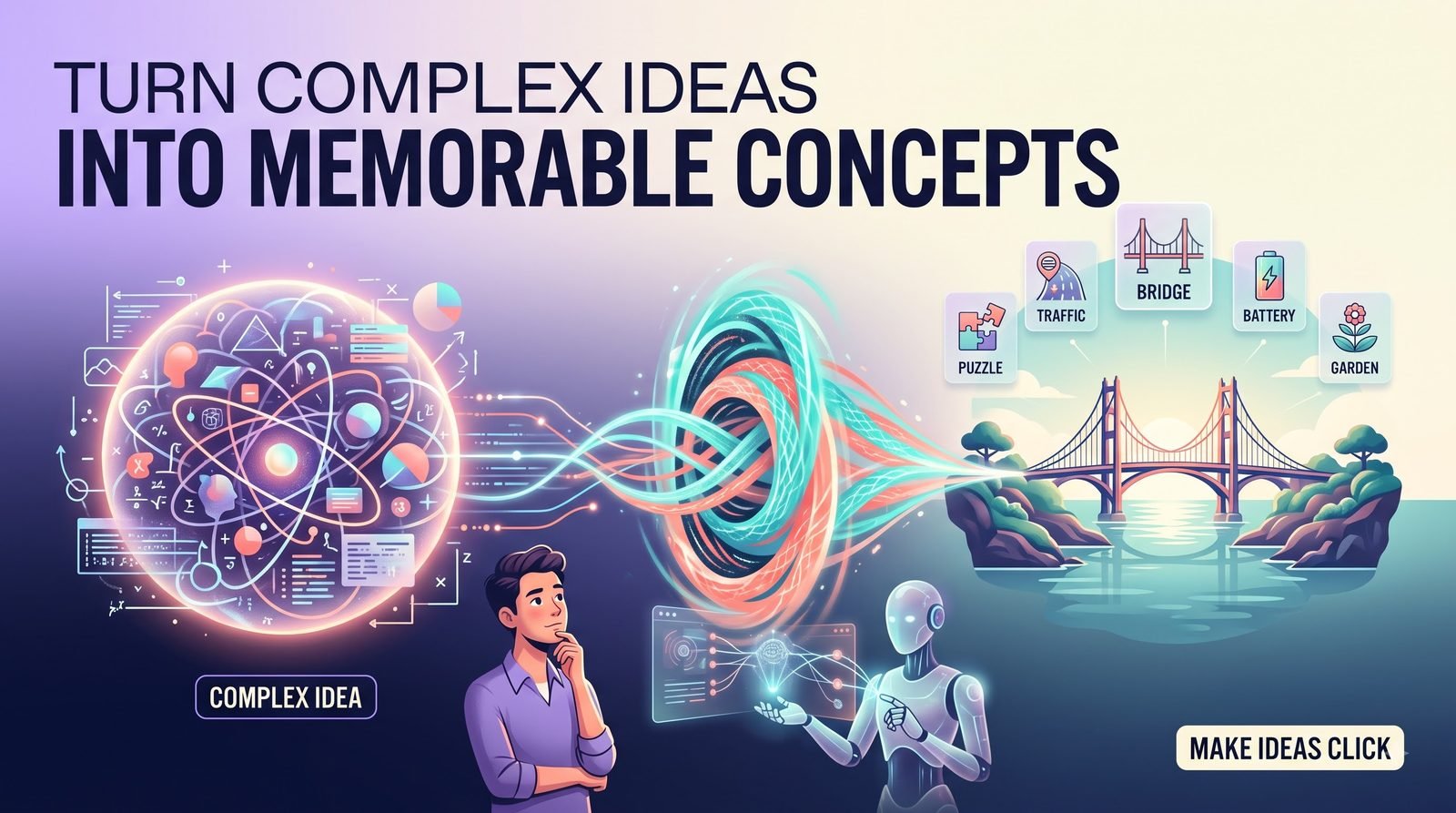
Some ideas are difficult to explain because the idea itself is complicated.
Others are difficult because they are abstract.
You can understand something perfectly in your own head, but when you try to explain it to someone else, the explanation becomes a wall of definitions.
That is where a good metaphor can help.
Instead of explaining an abstract idea directly, you connect it to something people already understand.
For example, describing a messy workflow as a traffic jam immediately creates a mental picture.
The cars represent tasks.
The blocked intersection represents the bottleneck.
The growing line represents accumulated work.
The metaphor does not replace the real explanation. It gives the audience a mental model for understanding it.
This prompt helps you find those kinds of connections.
Why Metaphors Are Useful
A strong metaphor can make an unfamiliar concept easier to visualize.
Think about explaining:
Information overload
You could describe the problem using several paragraphs.
Or you could say:
“It is like trying to drink from a fire hose.”
The second explanation creates an immediate image.
That does not mean every complex idea needs a metaphor.
The metaphor should make the concept clearer, not make it more confusing.
The Best Metaphors Have a Reason
A random comparison is not necessarily useful.
Suppose you are explaining a complicated project-management process and compare it to a banana.
That may be creative, but creativity alone does not make the analogy meaningful.
A stronger metaphor shares an important structural relationship with the original idea.
For example:
Project bottleneck → Traffic bottleneck
Both involve flow.
Both involve accumulation.
Both can be slowed by one restricted point.
That structural similarity gives the metaphor explanatory value.
One Idea Can Have Several Metaphors
There is rarely only one possible metaphor.
Take the concept of building a skill.
It could be compared to:
- Building a house
- Training for a marathon
- Learning a musical instrument
- Growing a garden
- Leveling up in a game
Each metaphor emphasizes something different.
House: Foundation before advanced construction.
Marathon: Consistency over time.
Instrument: Practice and feedback.
Garden: Patience and gradual development.
Game: Progression through levels.
The best choice depends on what you want the audience to understand.
Choose the Metaphor for the Audience
A metaphor that works for one audience may fail for another.
A software developer may immediately understand a programming analogy.
A child probably will not.
A business audience may respond well to supply-chain or market metaphors.
A general audience may connect more easily with everyday experiences.
The prompt therefore asks AI to consider the target audience before selecting the final concept.
Avoid Forced Analogies
One of the biggest problems with AI-generated metaphors is that they can sound clever without actually explaining anything.
For example:
“Your marketing strategy is like a butterfly because both require transformation.”
That does not provide much useful insight.
A better metaphor would connect to a specific mechanism.
For example:
“Your marketing funnel is like a shop entrance. Getting more people through the door does not help much if visitors cannot find what they came to buy.”
Now the comparison has a purpose.
It explains a relationship.
Use Metaphors for Content Creation
This prompt can be useful when creating:
- YouTube videos
- Blog posts
- Presentations
- Educational content
- Social media posts
- Product explanations
- Brand campaigns
- Training material
- Workshops
- Speeches
It is especially useful when your subject is technical or abstract but your audience needs a simple way into the topic.
Turn the Metaphor Into a Visual
The prompt does more than generate a comparison.
It can also describe what the metaphor could look like visually.
Suppose the concept is:
Too many priorities reduce focus.
A useful metaphor might be:
A camera trying to focus on ten subjects at once.
The visual could show one sharp subject surrounded by several blurred competing subjects.
Now the idea can become:
- A presentation slide
- A YouTube thumbnail
- An illustration
- A social media graphic
- A short video scene
The metaphor becomes a creative direction.
Use Contrast to Make the Idea Stronger
Some of the most memorable metaphors contain a before-and-after contrast.
For example:
Before: A tangled set of cables.
After: One organized cable path.
This can represent:
Complex workflow → Simplified workflow
The audience can understand the transformation visually before hearing the detailed explanation.
That is especially powerful for educational content.
Do Not Let the Metaphor Replace Reality
A metaphor is a communication tool.
It is not proof.
If you compare a business process to a machine, that does not mean the two systems behave identically.
A good metaphor should clarify the relevant relationship while making its limits clear when necessary.
The prompt therefore asks AI to explain what the metaphor captures and where the comparison stops being useful.
Find the “Aha” Moment
The strongest metaphor often produces a small moment of recognition.
The audience thinks:
“Oh, now I understand what you mean.”
That is the target.
Not the most unusual comparison.
Not the funniest comparison.
Not the most complicated one.
The one that makes the underlying idea easier to see.
MASTER PROMPT — COPY & PASTE
Act as a creative concept strategist specializing in metaphors and visual storytelling.

CORE IDEA:
[Describe the idea, concept, problem, process, or abstract subject]

TARGET AUDIENCE:
[Describe the audience]

PURPOSE:
[Explain / Teach / Sell / Present / Entertain / Inspire]

CONTEXT:
[Add any useful background]

Create meaningful metaphors that make the core idea easier to understand and remember.

Generate 7 different metaphor concepts.

For each metaphor, provide:

- METAPHOR
Explain what the idea is being compared to.

- CONNECTION
Explain the specific structural or conceptual similarity.

- WHAT IT CLARIFIES
Explain which part of the original idea becomes easier to understand.

- VISUAL CONCEPT
Describe how the metaphor could be represented in an image, presentation, video, or illustration.

- HOOK
Write one short opening line using the metaphor.

- LIMITATION
Explain where the metaphor stops being accurate or useful.

Then:

1. Remove metaphors that are generic, forced, confusing, or too similar.
2. Rank the 3 strongest concepts for the target audience.
3. Choose the single strongest metaphor.
4. Explain why it creates the clearest mental model.
5. Expand the chosen metaphor into a short visual storytelling concept with a beginning, middle, and end.
6. Give 5 alternative visual treatments of the same metaphor.

Rules:
- Prioritize meaningful structural connections over surface similarities.
- Do not force a metaphor simply to sound creative.
- Avoid clichés when a fresher comparison would communicate better.
- Do not claim the metaphor proves the underlying idea.
- Clearly identify the limits of the comparison.
- Keep the final concept simple enough to understand quickly.
Try the Same Idea From Different Directions
If the first metaphor does not feel right, do not immediately abandon the idea.
Change the perspective.
Suppose you are explaining decision fatigue.
One metaphor might be:
A phone battery being drained by dozens of background apps.
That focuses on depleted mental energy.
Another might be:
A restaurant menu with 500 choices.
That focuses on excessive options.
Another could be:
A computer with too many programs running simultaneously.
That focuses on cognitive overload.
The concept is the same.
The explanation changes.
Metaphors Can Become Content Series
Once you find a strong metaphor, you can build several pieces around it.
For example:
Topic: Workflow bottlenecks
Metaphor: Traffic jam
Then create:
What causes the traffic jam?
Why adding more cars does not solve it
How to identify the blocked intersection
What happens when the bottleneck moves
How to redesign the road
A single conceptual metaphor can therefore provide a consistent creative foundation without making every piece identical.
Use Familiar Things Before Complicated Ones
When choosing a metaphor, everyday experiences are often surprisingly powerful.
People understand:
- Traffic
- Queues
- Cooking
- Maps
- Gardening
- Building
- Sports
- Puzzles
- Clocks
- Batteries
- Doors
- Bridges
because they already have mental models for them.
You do not need an exotic analogy to create something memorable.
Sometimes the most effective metaphor is hiding inside something people experience every day.
Make the Visual Do Some of the Explaining
If the metaphor is being used visually, avoid putting everything into text.
Let the image communicate part of the idea.
For example, if the concept is information overload, a person buried under hundreds of papers communicates the basic problem immediately.
The supporting text can then explain the deeper point.
That creates a stronger combination:
Visual recognition + simple explanation + deeper insight
Instead of forcing the audience to read everything before they understand the concept.
Test the Metaphor Without Explaining It
There is a simple way to test whether a metaphor is doing its job.
Show the metaphor to someone and ask:
“What idea do you think this represents?”
If they consistently understand the intended concept, the visual relationship is probably strong.
If you need several minutes to explain why the comparison makes sense, the metaphor may be too complicated.
The best metaphors often feel obvious after you see them.
A Good Metaphor Gives the Audience Something to Hold Onto
Complex ideas are easier to remember when they have a mental image attached to them.
Instead of remembering a paragraph about bottlenecks, someone may remember:
“The narrow bridge is slowing the whole line of traffic.”
That mental picture becomes a shortcut back to the underlying concept.
Use this prompt when an idea is technically correct but difficult to communicate.
The goal is simple:
Take something abstract, connect it to something familiar, and make the idea easier to see.