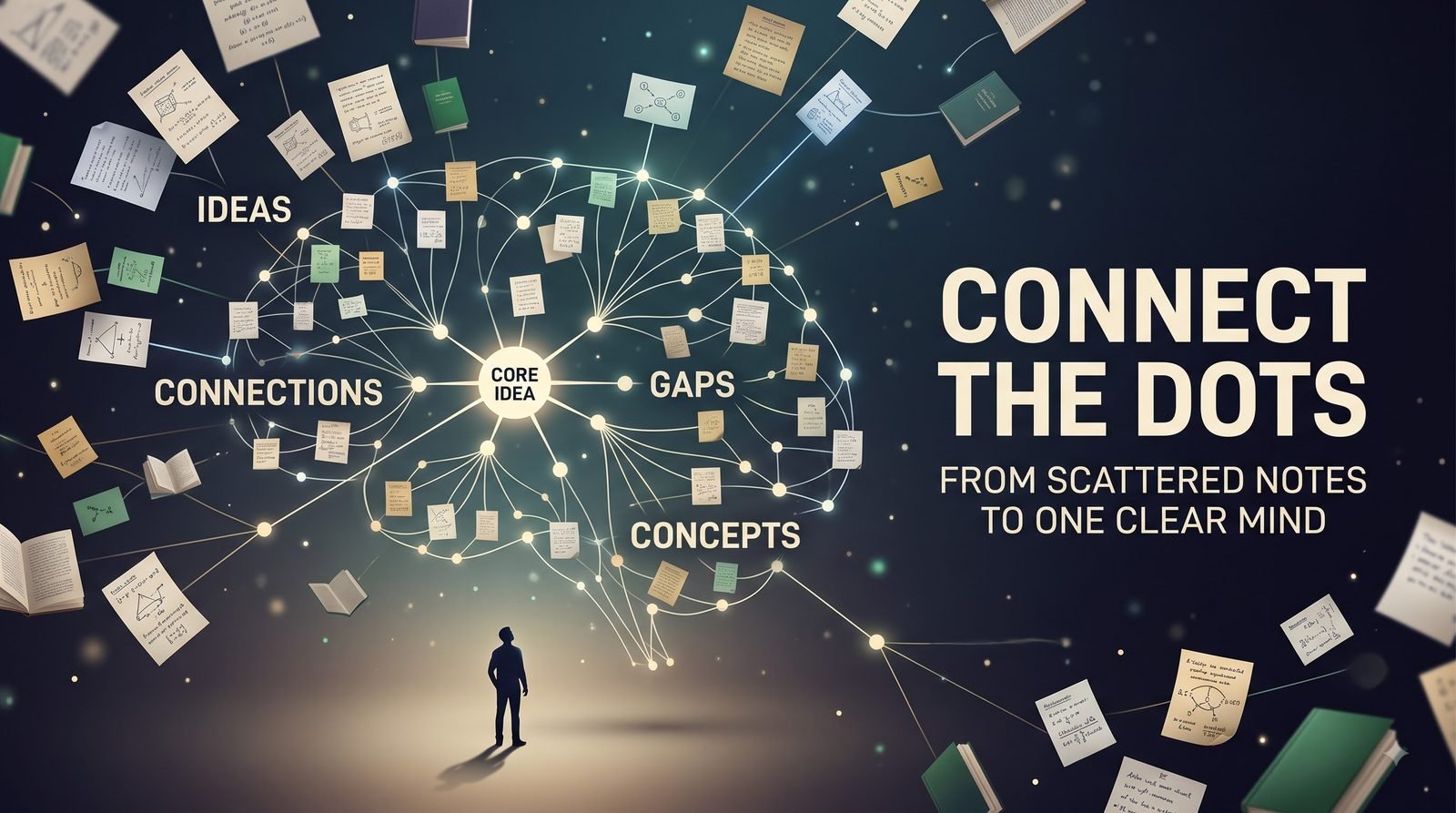
Information becomes difficult to use when it exists as isolated pieces.
One note explains a concept.
Another contains an example.
A third mentions a related idea.
Later, you remember reading something useful, but you cannot remember how it connects to everything else you know.
That is where a knowledge map becomes useful.
Instead of asking AI to simply summarize your material, you can ask it to identify the relationships between ideas and organize them into a structure you can actually navigate.
Think in Connections, Not Just Notes
Imagine you are learning about digital marketing.
You might have separate notes about:
- Audience research
- Content strategy
- Search intent
- Copywriting
- Analytics
- Conversion
- Distribution
A conventional summary could explain each topic separately.
A knowledge map goes one step further.
It might reveal that:
Audience research → influences search intent
Search intent → influences content strategy
Content strategy → affects conversion opportunities
Analytics → reveals whether those decisions worked
Now the information becomes a system rather than a pile of notes.
What the Prompt Actually Does
The prompt analyzes your material and looks for:
Core concepts
What ideas appear central to the subject?
Supporting concepts
Which ideas explain, expand, or depend on those core concepts?
Relationships
How are the concepts connected?
Themes
Which ideas naturally belong together?
Knowledge gaps
Where does your current material appear incomplete?
Potential confusion
Which concepts are similar enough that they could easily be mixed up?
This makes the output more useful than a conventional summary.
Give AI Your Existing Material
You can feed the prompt:
- Research notes
- Study notes
- Book notes
- Course material
- Project documentation
- Brain dumps
- Multiple documents
- Personal observations
- Collected articles or excerpts
The material does not have to be perfectly organized beforehand.
In fact, messy information is often where this workflow provides the most value.
Preserve the Difference Between Facts and Connections
There is an important distinction here.
Your source material may explicitly state:
Concept A affects Concept B.
But sometimes the relationship is only implied.
The prompt should distinguish between:
Explicit relationship: directly supported by the material.
Inferred relationship: a reasonable connection identified by analysis.
That prevents the knowledge map from quietly turning interpretation into established fact.
Find the Missing Pieces
One of the most valuable outputs is the knowledge gap section.
Suppose your notes cover:
Problem → Solution → Implementation
but contain almost nothing about:
Measurement
The map can highlight that missing area.
That does not automatically mean you must study it.
It simply gives you a useful question:
“Is this missing because it is unnecessary, or because I have not learned it yet?”
That is a much better starting point for deeper research.
Spot Confusing Concepts
Knowledge becomes fragile when related concepts are mentally blended together.
For example:
Strategy
and
Tactics
may appear repeatedly in the same material, but they are not interchangeable.
A useful knowledge map can flag these relationships and explain the distinction.
This makes the system valuable for revision, teaching, writing, and decision-making.
Build a Map Around Your Goal
The same information can be organized differently depending on what you want to do with it.
If you are studying, the map should emphasize:
foundations → concepts → relationships → advanced topics
If you are working on a project, it may emphasize:
objective → components → dependencies → decisions → outcomes
If you are preparing content, it may emphasize:
audience → themes → concepts → examples → applications
So tell the AI what you are trying to accomplish.
The map should support the purpose, not simply organize information for the sake of organization.
MASTER PROMPT — COPY & PASTE
Act as a knowledge architect and information-structure analyst.

My goal:
[Explain what I want to learn, understand, organize, research, or accomplish]

SOURCE MATERIAL:
[Paste your notes, research, documents, ideas, excerpts, or other information here]

Analyze the material and build a practical knowledge map.

STRUCTURE THE OUTPUT AS:

1. CENTRAL IDEA
Identify the main subject or organizing concept.

2. CORE CONCEPTS
List the most important concepts and briefly explain each one.

3. SUPPORTING CONCEPTS
Identify ideas that explain, extend, provide examples for, or depend on the core concepts.

4. RELATIONSHIPS
Show the meaningful connections between concepts.
Use relationship descriptions such as:
- leads to
- depends on
- influences
- explains
- contrasts with
- supports
- is an example of

5. KNOWLEDGE CLUSTERS
Group closely related concepts into logical themes.

6. CONCEPT HIERARCHY
Arrange the subject from foundational ideas to more advanced or dependent ideas where appropriate.

7. IMPORTANT DISTINCTIONS
Identify concepts that could easily be confused and explain the difference between them.

8. KNOWLEDGE GAPS
Identify important areas that appear missing, weakly covered, or insufficiently explained in the source material.

9. UNCERTAIN CONNECTIONS
Separate relationships that are explicitly supported by the material from relationships that are analytical inferences.

10. PRACTICAL APPLICATIONS
Show how the connected knowledge could be used in real situations relevant to my stated goal.

11. LEARNING OR ACTION PATH
Recommend a logical sequence for what I should understand, investigate, practice, or apply next.

12. COMPACT KNOWLEDGE MAP
Finish with a concise text-based map showing the most important concepts and their relationships.

RULES:
- Base the map primarily on the supplied material.
- Do not invent facts that are absent from the material.
- Clearly label reasonable inferences as inferences.
- Do not treat a mention of two concepts as proof that they are causally related.
- Preserve important distinctions and terminology from the source material.
- Remove repetition without removing meaningful relationships.
- Prioritize useful connections over decorative complexity.
- If the source material is too incomplete to establish a relationship, say so.
- Make the final structure easy to scan and reuse.
Use It Before Adding More Information
There is a temptation to keep collecting information whenever something feels unclear.
That can make the problem worse.
Before searching for another article or saving another note, run your existing material through the prompt.
You may discover that the problem is not lack of information.
It may simply be that the information is poorly connected.
Turn the Map Into a Learning Plan
Once the relationships are visible, the next step becomes easier.
You can ask:
What should I understand first?
Which concept depends on another?
Where is my biggest knowledge gap?
Which distinction do I keep missing?
What should I practice rather than merely read about?
The knowledge map therefore becomes a bridge between information collection and actual understanding.
Rebuild the Map as Your Knowledge Grows
A knowledge map should not be treated as a permanent document.
New research can change your understanding.
A previously minor concept may become important.
Two concepts you thought were unrelated may turn out to be connected.
Running the workflow again with updated material can reveal those changes.
That makes the map a living representation of your current understanding rather than a static summary.
Make Your Information Work Together
The real value of personal knowledge is not how many notes you have.
It is how easily you can connect those notes when you need them.
This prompt helps turn scattered information into a structure of concepts, relationships, themes, distinctions, gaps, and next steps.
Instead of asking AI, “What do my notes say?”, you can ask a more useful question:
“How does everything I know here fit together?”