Information is everywhere.
The difficult part is no longer finding something to read. It is deciding whether the information deserves your trust.
A confident headline can make a weak claim sound convincing. A professional-looking website can create an impression of authority. A statistic can appear impressive without telling you where it came from or what it actually measures.
Even information that is broadly correct can become misleading when important context is removed.
That is why evaluating a source requires more than asking whether it “looks reliable.”
This prompt gives you a structured way to examine the reasoning behind a claim.
Start With the Claim
Before evaluating a source, separate the actual claim from everything surrounding it.
For example:
“A new study proves that working four days a week makes every company more productive.”
That sentence contains a strong conclusion.
But what exactly was studied?
Which companies?
What does “more productive” mean?
Was the study observational or experimental?
Was the result statistically meaningful?
Did the research actually support the word “proves”?
These questions can dramatically change how you interpret the original statement.
A Source Can Be Real and Still Be Misleading
This is an important distinction.
A genuine research paper can be summarized inaccurately.
A legitimate news article can quote a study without providing enough context.
A government report can contain accurate data that someone later uses to support a conclusion the report itself never made.
So credibility is not simply:
Real source = true claim
There is another layer.
You need to examine whether the source actually supports the specific claim being made.
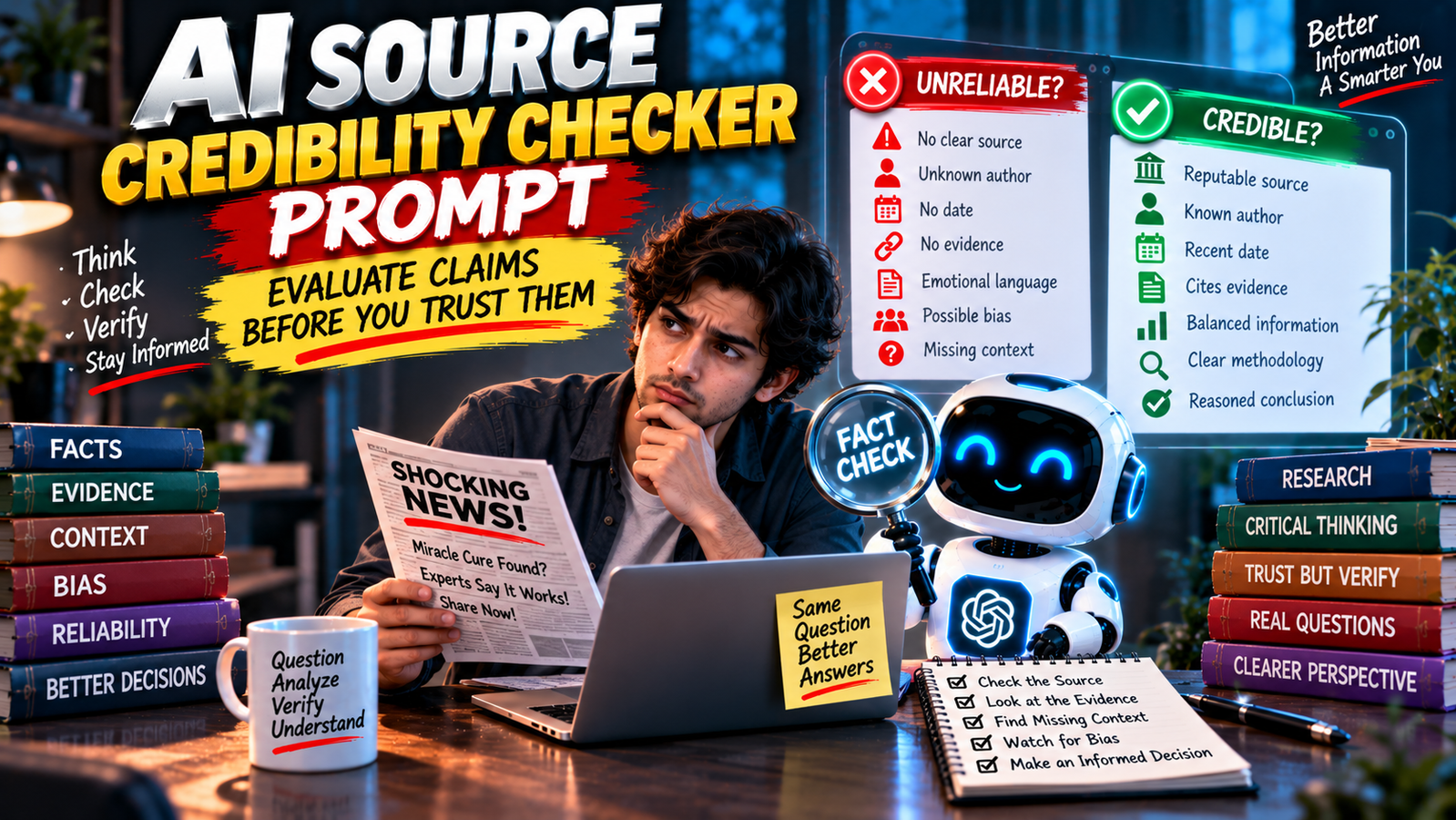
What This Prompt Checks
The prompt examines the information from several directions:
- The exact claim
- Evidence provided
- Source quality
- Author or organization
- Date and relevance
- Methodology when available
- Possible conflicts of interest
- Missing context
- Logical leaps
- Strength of the conclusion
- Uncertainty
It also asks AI to distinguish between what can be verified from the supplied material and what would require additional checking.
That prevents the analysis from creating false confidence.
Evidence Is Not All the Same
Consider three statements:
“Many people believe this.”
That tells you about opinion.
“A survey of 500 people found this.”
That provides some evidence, but the survey design and sample matter.
“A controlled study found this under specific conditions.”
That may provide stronger evidence for a particular type of conclusion.
The point is not to automatically rank one source type above every other source.
Different evidence is useful for different questions.
The important thing is understanding what the evidence can actually establish.
Watch the Jump From Evidence to Conclusion
This is one of the most common problems in online information.
A source may report:
“People who perform activity X have outcome Y.”
Someone then concludes:
“Activity X causes outcome Y.”
Those are not necessarily equivalent.
There may be other explanations.
Perhaps another variable influences both.
Perhaps the study only found an association.
Perhaps the sample was too narrow to support a broader conclusion.
The prompt specifically looks for these reasoning jumps.
Dates Matter
Information can become outdated even when the original source was credible.
A technical recommendation, software feature, market condition, regulation, product specification, or scientific understanding may change.
That does not mean an old source is automatically useless.
It means you need to consider whether its age matters for the particular claim.
The prompt therefore asks you to examine publication date and relevance rather than treating all sources as timeless.
Look for Missing Context
Sometimes the most important information is what the source leaves out.
A headline may report a percentage without providing the underlying numbers.
A study may report a result without explaining the limitations.
A product comparison may highlight advantages while ignoring important trade-offs.
A personal story may be genuine but not representative of typical outcomes.
The prompt asks AI to identify these missing pieces.
That can help you decide what additional information is worth investigating.
Try It on Online Claims
You can use the prompt with:
- Articles
- Research summaries
- Blog posts
- Product claims
- Social media posts
- Marketing statements
- Business reports
- Educational material
- News excerpts
- Statistics
- Advice you are considering following
Paste the claim and the relevant source material.
The more original context you provide, the better the analysis can distinguish what the source actually says from what someone else claims it says.
Do Not Ask AI to “Tell Me If It Is True”
That question is often too broad.
A better approach is:
What exactly is being claimed?
What evidence supports it?
What does the evidence actually establish?
What remains uncertain?
This creates a more useful investigation.
AI should help structure the evaluation, not become an unquestioned authority itself.
A Practical Example
Suppose you see an article claiming:
“This productivity technique saves professionals five hours every week.”
Before accepting the statement, you could examine:
Claim: Users save five hours per week.
Evidence: What study, survey, experiment, or data supports the number?
Population: Who was studied?
Measurement: How was “time saved” calculated?
Context: Was the result based on a specific workflow?
Generalization: Does the evidence justify applying the result to everyone?
Uncertainty: What information is missing?
Now you have a much clearer basis for deciding how much confidence to place in the claim.
MASTER PROMPT — COPY & PASTE
Act as a careful source and claim evaluation analyst.

CLAIM:
[Paste the exact claim]

SOURCE MATERIAL:
[Paste the article, excerpt, study summary, report, post, or other material]

SOURCE INFORMATION:
[Author, organization, publication date, URL, or other available details]

CONTEXT:
[Explain how or where I encountered this claim and why it matters]

Evaluate the claim based only on the information provided.

Analyze:

1. CLAIM BREAKDOWN
Rewrite the main claim in precise terms and identify any strong or ambiguous wording.

2. SOURCE
Identify who produced the information, what type of source it is, and any relevant source limitations visible from the material.

3. EVIDENCE
Summarize the evidence directly supporting the claim.

4. EVIDENCE QUALITY
Assess how strong, relevant, and sufficient the provided evidence appears to be.

5. REASONING
Check whether the conclusion follows from the evidence or whether there are logical jumps, unsupported assumptions, or possible confusion between correlation and causation.

6. MISSING CONTEXT
Identify important information that is missing and could change the interpretation.

7. BIAS AND INCENTIVES
Identify potential conflicts of interest, selective presentation, persuasive framing, or other factors that could affect interpretation, but do not assume bias without evidence.

8. SCOPE
Explain exactly what the evidence supports and what it does not establish.

9. UNCERTAINTY
List the important unknowns and assign an overall confidence level of High, Medium, or Low based only on the supplied material.

10. VERIFICATION PLAN
Suggest the most useful additional sources, data, or checks that should be consulted before relying heavily on the claim.

11. FINAL ASSESSMENT
Classify the claim as:
- Well supported by the provided evidence
- Partially supported
- Weakly supported
- Unsupported by the provided evidence
- Cannot be determined from the available material

Explain the classification briefly.

Rules:
- Do not invent sources, studies, statistics, authors, or facts.
- Do not claim something has been independently verified unless verification was actually performed.
- Do not treat a professional appearance as evidence of credibility.
- Clearly distinguish facts, interpretations, assumptions, and unknowns.
- Do not confuse absence of evidence with evidence that a claim is false.
- If the provided material is insufficient, say so clearly.
Use the Original Wording Whenever Possible
If you are checking something you found online, copy the exact claim instead of paraphrasing it.
Compare:
“The article says this method works.”
with:
“The article states that participants using the method completed tasks 18% faster.”
The second version gives the analysis something concrete to examine.
Small wording differences can completely change the strength of a claim.
Separate Source Quality From Claim Strength
A reputable source can publish a weakly supported conclusion.
A less prestigious source can sometimes point you toward a legitimate piece of evidence.
These are separate questions.
You should ask:
How trustworthy is the source?
and:
How well does the evidence support this particular claim?
The prompt keeps those questions separate.
That produces a more nuanced assessment than simply labeling a website “reliable” or “unreliable.”
Use It Before Sharing Information
This workflow can also be useful before passing information to other people.
If a statistic or claim looks interesting, run it through the analysis first.
You may discover that the underlying source is solid but the headline exaggerated the conclusion.
Or you may discover that the claim cannot be evaluated properly without additional information.
That small pause can prevent weak information from being repeated as fact.
When AI Cannot Verify Something
This is where disciplined prompting matters.
If you give AI a single paragraph with no supporting sources, it may be able to analyze the logic and identify questions, but it cannot magically establish whether every factual statement is true.
That limitation should be visible in the output.
A good analysis can say:
“The material provided does not contain enough evidence to determine this.”
That is a useful answer.
False certainty is not.
Build a Better Information Habit
You do not need to investigate every sentence you encounter.
Focus deeper attention on claims that could influence an important decision, purchase, professional recommendation, research conclusion, or public statement.
A simple mental sequence is enough:
Claim → Source → Evidence → Context → Reasoning → Uncertainty
Once you start thinking this way, information becomes easier to evaluate without automatically believing it or automatically rejecting it.
The objective is not skepticism for its own sake.
It is knowing how much confidence a claim has actually earned.