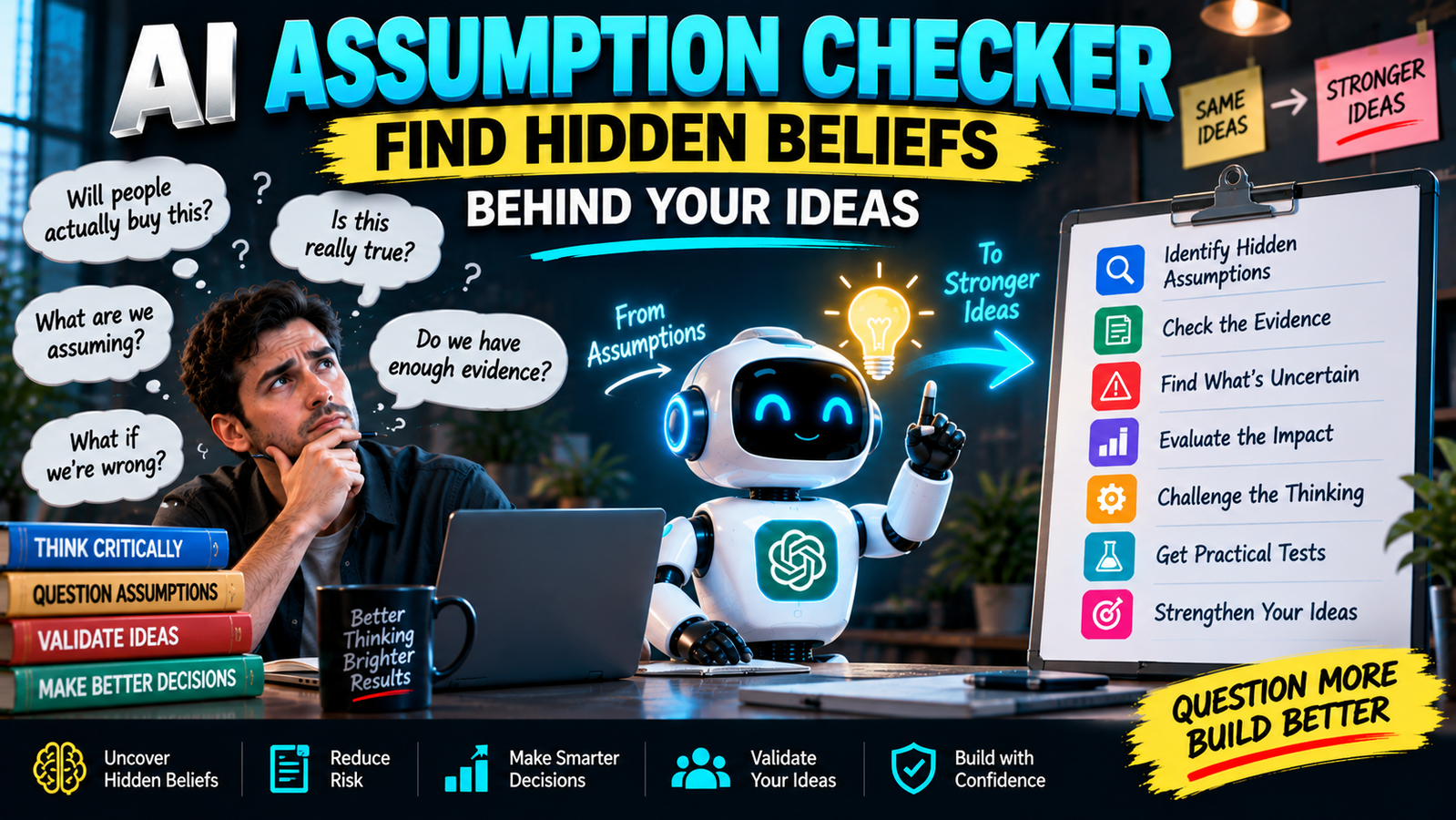
Prompt: Find Hidden Beliefs Behind Your Ideas.
A lot of decisions look logical on the surface.
But underneath them are assumptions.
You might think:
“People will buy this because they already use similar products.”
Or:
“This strategy should work because it worked for another company.”
Or even:
“I don’t have enough time to learn this.”
Each statement may be reasonable.
But each one also contains something that has not necessarily been proven.
That hidden layer is where mistakes often begin.
An assumption is essentially something you are treating as true while making a decision, even though you may not have fully verified it.
The problem is that assumptions are easy to overlook because they often feel obvious.
This prompt is designed to make them visible.
Why Assumptions Deserve Attention
Imagine you are planning to launch an online course.
Your reasoning might look like this:
People want to learn the subject → they will pay for a course → they will find your course → they will finish it → the course will generate worthwhile revenue.
Every arrow contains an assumption.
Maybe people are interested in the topic but prefer free content.
Maybe they would pay, but not at your proposed price.
Maybe your target audience is difficult to reach.
Maybe completion rates are low.
The course itself might be excellent, but the surrounding assumptions could still make the business model weak.
Checking those assumptions before investing significant time can improve the quality of the decision.
Not Every Assumption Is Bad
An assumption is not automatically a problem.
Everyday decisions require assumptions because you cannot verify everything.
The useful question is:
Which assumptions are important enough to test?
That is why this prompt does more than produce a list of assumptions.
It asks AI to consider their importance, supporting evidence, uncertainty, and potential impact.
A small assumption with little consequence may not deserve much attention.
A weak assumption sitting at the center of a major decision deserves much more scrutiny.
What the Prompt Looks For
The analysis focuses on several layers:
- Explicit assumptions
- Hidden assumptions
- Evidence supporting them
- Evidence that could challenge them
- Missing information
- Importance of each assumption
- Potential consequences if an assumption is wrong
- Practical ways to test important assumptions
This makes the output useful for planning rather than simply philosophical analysis.
A Simple Example
Suppose someone says:
“We should create more short-form videos because our competitors are getting good results from them.”
There are several assumptions hiding inside that statement.
Perhaps:
- The same audience exists on the chosen platform.
- Competitor results are actually caused by short-form video.
- Their production quality or distribution strategy is comparable.
- More videos will produce similar results.
- The team can maintain the required publishing frequency.
- The expected benefit justifies the production cost.
None of these assumptions are necessarily wrong.
But they are worth examining.
The important question becomes:
Which one could most seriously change the decision if it turns out to be false?
That is the kind of reasoning this prompt is designed to encourage.
Use It Before Building Something
This is particularly useful before committing resources.
You can use it on:
- Business ideas
- Product concepts
- Marketing strategies
- Content plans
- Project proposals
- Career decisions
- Learning plans
- Personal goals
- New workflows
The earlier you identify a critical assumption, the easier it usually is to test.
Finding out that an idea depends on a questionable assumption before execution is far more useful than discovering it after months of work.
Separate Facts From Beliefs
One of the strongest features of this workflow is the distinction between what you know and what you believe.
Consider:
“Our customers want faster delivery.”
Is that a fact?
Maybe you have survey responses showing it.
Maybe several customers have specifically requested it.
Or perhaps you simply believe it because faster delivery seems attractive.
Those are very different situations.
The prompt asks AI to distinguish between evidence and interpretation instead of treating every statement as equally reliable.
That alone can improve the quality of strategic thinking.
Use It on Your Own Reasoning
You can also paste your personal reasoning directly into the prompt.
For example:
“I think I should start freelancing because I can make more money independently.”
The AI can help identify assumptions behind that conclusion.
Maybe you are assuming:
- There is enough demand for your skills.
- You can consistently find clients.
- Your current skill level is commercially competitive.
- You can handle irregular income.
- Client acquisition will not consume too much time.
This does not mean the decision is wrong.
It simply means the decision becomes easier to evaluate once the hidden assumptions are visible.
The Most Important Output
Do not focus only on the number of assumptions found.
Focus on the high-impact assumptions.
If an assumption is both uncertain and capable of significantly changing the outcome, it deserves attention.
For example:
Assumption: Customers will pay $50 per month.
Evidence: Ten existing users said they would consider paying.
Uncertainty: Actual purchasing behavior has not been tested.
Impact if wrong: High.
Useful test: Offer the product at the proposed price to a small group before a larger launch.
That is actionable reasoning.
MASTER PROMPT — COPY & PASTE
Act as a rigorous critical-thinking and assumption analysis expert.

I will provide an idea, decision, plan, strategy, argument, or belief.

MY IDEA / DECISION:
[Enter the idea, decision, plan, or reasoning]

CONTEXT:
[Provide relevant background, evidence, constraints, or goals]

Analyze the reasoning and uncover the assumptions underneath it.

Identify:

1. EXPLICIT ASSUMPTIONS
List assumptions directly stated or clearly visible in the reasoning.

2. HIDDEN ASSUMPTIONS
Identify important assumptions that are implied but not directly stated.

3. EVIDENCE
For each important assumption, identify what evidence supports it based only on the information provided.

4. UNCERTAINTY
Explain what is known, what is uncertain, and what has not been established.

5. IMPACT
Estimate whether each assumption has Low, Medium, or High potential impact if it turns out to be wrong.

6. PRIORITY
Rank the most important assumptions based on:
- How uncertain they are
- How much the decision depends on them
- How seriously the outcome could change if they fail

7. CHALLENGE
For the highest-priority assumptions, explain what evidence or alternative explanation could challenge them.

8. TESTING
Suggest practical, low-cost ways to test the most important assumptions before making a major commitment.

9. REASONING GAPS
Identify any logical gaps, unsupported conclusions, or important information missing from the original reasoning.

10. FINAL ASSESSMENT
Give a concise assessment of whether the reasoning appears well-supported, assumption-heavy, or impossible to judge with the available information.

Rules:
- Do not treat assumptions as facts.
- Do not invent evidence.
- Do not assume a conclusion is wrong simply because it contains assumptions.
- Clearly distinguish facts, assumptions, interpretations, and unknowns.
- Focus on assumptions that could materially affect the outcome.
- Prioritize practical verification over abstract criticism.
A Better Question to Ask After the Analysis
Once the assumptions are identified, do not immediately try to eliminate all uncertainty.
Ask:
“Which assumption should I test first?”
That question keeps the process practical.
If one assumption has high uncertainty and high impact, testing it should usually receive more attention than investigating five minor assumptions.
You can then use the result to update your original idea.
That creates a useful cycle:
Idea → Assumptions → Evidence → Test → Updated Idea
Instead of simply asking AI whether your idea is good, you are examining the structure that makes the idea believable.
Why This Can Improve Decision Quality
Strong decisions do not require perfect certainty.
That is rarely possible.
What matters is understanding where uncertainty exists and knowing which uncertainties actually matter.
An assumption checker helps bring those hidden dependencies into the open.
Sometimes the result will strengthen your original idea because the important assumptions are well supported.
Sometimes it will reveal a serious weakness.
And sometimes it will show that you simply do not have enough information yet.
All three outcomes are useful.
The real advantage is not getting AI to approve or reject your thinking.
It is getting a clearer view of what your thinking is built on.