Most problem-solving advice starts with an ideal situation.
You have enough money.
You have enough people.
You have enough time.
You have the right tools.
And everyone involved is available.
Real life rarely works that way.
A project may have to be completed with half the expected budget. A small team may have to handle work originally designed for a larger group. You may have only two hours to finish something that could easily take a full day.
That changes the problem.
The best solution is no longer the one that would work under perfect conditions.
It is the one that works within the conditions you actually have.
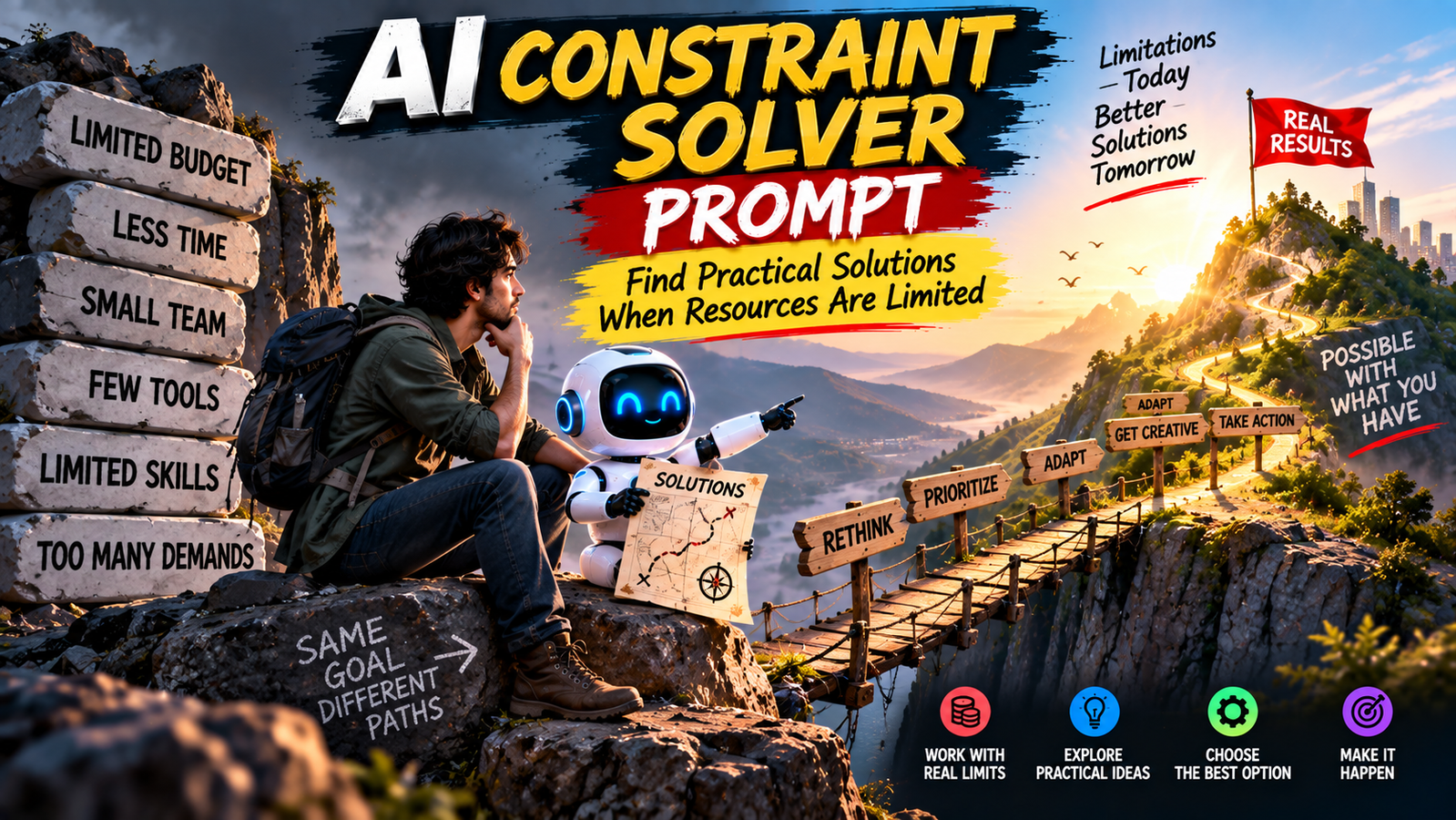
This prompt is designed for exactly that situation.
Constraints Change the Solution
Imagine you want to launch a small online product.
Under ideal circumstances, you might:
- Hire a designer
- Hire a developer
- Run extensive research
- Build custom software
- Spend heavily on advertising
But suppose your actual constraints are:
Budget: $300
Team: One person
Time: Two weeks
Technical skill: Basic
Audience: Small existing community
The original plan is no longer realistic.
That does not mean the goal has to disappear.
It means the solution needs to change.
The constraint-solving approach forces the AI to work inside the boundaries rather than quietly ignoring them.
What Counts as a Constraint?
A constraint is anything that meaningfully limits the available options.
It could be:
- Time
- Budget
- People
- Skills
- Technology
- Equipment
- Information
- Location
- Access
- Legal or organizational requirements
- Quality requirements
- Deadlines
- Physical limitations
Some constraints are fixed.
Others may be negotiable.
That distinction matters.
If a deadline is legally fixed, you cannot simply recommend moving it.
If a deadline is only an internal preference, changing it may be one of the possible solutions.
The prompt asks AI to make that distinction instead of treating every limitation as equally rigid.
Start With the Goal
A constraint is only meaningful relative to an objective.
For example:
“I have only three hours.”
That information alone does not tell us much.
Three hours may be enough to create a presentation but not enough to build a complete software product.
So the prompt begins by defining what you are actually trying to accomplish.
Once the goal is clear, the AI can determine which constraints matter most.
Hard Constraints vs. Soft Constraints
This is one of the most useful distinctions in the workflow.
Hard Constraint
A condition that cannot realistically be changed.
Example:
“The event must happen on Saturday.”
Soft Constraint
A preference that could potentially be negotiated.
Example:
“I would prefer to finish before Saturday.”
Those situations should produce different solutions.
If AI treats every preference as an absolute restriction, it can unnecessarily shrink the solution space.
Do Not Optimize Everything
A common mistake is trying to satisfy every requirement perfectly.
Sometimes that is impossible.
Suppose you have:
- Very low budget
- Very short deadline
- Very high quality expectations
- Very small team
You may have to choose which objective matters most.
The right answer could be to reduce scope rather than lower quality.
Or delay a non-essential feature.
Or replace a custom solution with an existing tool.
The prompt asks AI to identify these trade-offs explicitly.
A Practical Example
Imagine a small business needs a customer feedback system.
The ideal solution might be a custom application.
But the constraints are:
- No developer
- Very small budget
- Need it within three days
- Only basic reporting required
A practical solution might involve an existing form tool, a structured spreadsheet, and an automated summary workflow.
It is not the most sophisticated system.
It may be the best system for the actual constraints.
That is an important difference.
Use It When You Feel Stuck
This prompt is particularly useful when your first solution keeps failing because of practical limitations.
Try it for:
- Business problems
- Project planning
- Content production
- Personal goals
- Travel planning
- Learning projects
- Small-team operations
- Product development
- Event planning
- Household organization
Instead of asking:
“What is the best solution?”
ask:
“What is the best solution that fits these constraints?”
That wording produces a very different kind of reasoning.
Give AI Permission to Challenge the Goal
Sometimes the goal itself is too broad.
If your objective is:
“Build a complete website in one weekend with no budget and no technical experience.”
The best response may not be a complicated workaround.
It may be to reduce the scope.
For example:
Full website → One-page landing page
That is not failure.
It is constraint-aware planning.
The prompt therefore asks AI to consider whether the goal needs to be narrowed, divided into stages, or redefined.
MASTER PROMPT — COPY & PASTE
Act as a practical constraint-based problem-solving strategist.

MY GOAL:
[Clearly describe what I want to accomplish]

CURRENT SITUATION:
[Describe the situation and relevant background]

CONSTRAINTS:
[List all known limits such as time, budget, people, skills, tools, access, location, quality requirements, or deadlines]

NON-NEGOTIABLES:
[List anything that absolutely cannot change]

PREFERENCES:
[List things I would prefer but could potentially change]

Analyze the problem and find realistic solutions that work within the actual constraints.

Provide:

1. GOAL DEFINITION
Clarify the exact outcome that needs to be achieved.

2. CONSTRAINT MAP
Separate hard constraints from flexible preferences.

3. BOTTLENECKS
Identify which constraints create the biggest limitations.

4. TRADE-OFFS
Explain what may need to be sacrificed, reduced, delayed, or changed.

5. SOLUTION OPTIONS
Create 3 to 5 realistic solutions that fit the constraints.

6. CREATIVE WORKAROUNDS
Find unconventional but practical ways to work around the most important limitations.

7. BEST OPTION
Choose the strongest solution and explain why it provides the best balance of feasibility, effort, cost, time, and outcome.

8. SIMPLIFY THE GOAL
If the original goal is unrealistic under the constraints, propose a smaller version that preserves the most important outcome.

9. EXECUTION PLAN
Turn the best option into clear steps in the correct order.

10. FAILURE RISKS
Identify what could prevent the recommended solution from working.

11. CONTINGENCY
Give a practical fallback plan if the main approach fails.

12. FINAL RECOMMENDATION
Summarize what I should do first, what I should avoid, and which constraint deserves the most attention.

Rules:
- Do not ignore stated constraints.
- Do not invent resources, people, skills, tools, or budget.
- Clearly distinguish hard constraints from assumptions or preferences.
- Do not recommend unrealistic solutions.
- Do not optimize for sophistication when a simpler solution would work.
- Identify trade-offs honestly.
- If the goal itself is unrealistic, say so and propose a practical reduced-scope alternative.
The Constraint List Is More Important Than It Looks
When using this prompt, spend a little time describing the limitations accurately.
Instead of:
“I have a small budget.”
Try:
“I can spend up to $200 and cannot increase the budget this month.”
Instead of:
“I have a small team.”
Try:
“Two people are available, and neither can work more than four hours per day on this project.”
Specific constraints make the resulting solutions much more grounded.
Ask for Multiple Paths
There is rarely only one way around a limitation.
If you have a budget problem, you might:
- Reduce scope
- Use an existing tool
- Delay a feature
- Find a cheaper substitute
- Change the delivery model
If you have a time problem, you might:
- Remove low-value steps
- Batch tasks
- Reduce scope
- Reuse existing assets
- Change the sequence of work
That is why the prompt generates several options before selecting one.
You get a solution space instead of a single guess.
The Best Solution May Change the Problem
Sometimes the smartest response to a difficult constraint is not finding a clever workaround.
It is changing the structure of the problem.
For example:
Original: Create 20 pieces of content this week.
Constraint: Only three hours are available.
Alternative: Create five strong pieces and turn each into multiple smaller formats.
The objective remains content distribution.
The method changes.
That is one of the most powerful ideas behind constraint-based thinking.
Use Constraints as Design Inputs
Limitations are usually treated as obstacles.
But they can also make decisions easier.
If you know the budget, deadline, available skills, and required outcome, many unsuitable options can be eliminated immediately.
That leaves a smaller set of realistic choices.
Instead of searching endlessly for the perfect solution, you can focus on the solutions that can actually survive contact with reality.
The goal is not to find a solution with no compromises.
It is to find the best achievable outcome within the world you are actually operating in.