AI Explanation Simplifier Prompt: Make Complex Topics Easy to Understand
Some explanations are technically correct but still difficult to follow.
The problem is often not the subject itself. It is the way the information is presented.
A complicated concept may contain unfamiliar terminology, several connected ideas, hidden assumptions, and processes that are difficult to visualize. If all of that is explained at the same level of complexity, the reader can quickly lose the thread.
This is where an explanation prompt can help.
Instead of simply asking AI to “explain this,” you can tell it to first understand the concept, identify what makes it difficult, and then rebuild the explanation around the learner.
The Goal Is Clarity, Not Just Simplicity
There is an important difference between making something simple and making it clear.
Oversimplifying a subject can remove important details and create misunderstandings.
A useful explanation should preserve the core idea while reducing unnecessary complexity.
For example, if you are learning how APIs work, saying “an API lets programs talk to each other” is a useful starting point, but it does not fully explain what happens.
A stronger explanation might introduce the basic idea first, then use a practical analogy, followed by a simple request-and-response example.
The learner gets the concept without being forced to understand every technical detail immediately.
What Makes This Prompt Different
The prompt is designed to adjust the explanation instead of producing the same type of answer for every subject.
It asks AI to consider:
- What the learner already knows
- Which terms need explanation
- What the central idea actually is
- Which analogy would help
- What example would make the concept concrete
- Which common misunderstanding should be addressed
- What should be learned next
That makes it useful for both complete beginners and people who already have some familiarity with a topic.
Give AI the Right Starting Point
One of the easiest ways to improve an explanation is to tell AI your current level.
Compare these two requests:
Explain quantum computing.
and:
I understand basic computers and binary numbers, but I do not understand quantum computing.
The second gives AI useful context.
You can go further by specifying what you are trying to accomplish.
For example:
I need to understand this well enough to explain it to a non-technical client.
That changes the explanation considerably.
You are no longer asking only for information. You are asking for usable understanding.
Use It for Difficult Reading
The prompt can also be useful when you encounter a complicated article, technical document, research concept, or unfamiliar subject.
Instead of asking AI to summarize everything, ask it to identify the central concept and teach it progressively.
This is especially useful when the source material assumes knowledge that you do not yet have.
You can provide the material as context and ask AI to explain the difficult parts while preserving the original meaning.
A Practical Example
Suppose you want to understand compound interest.
A basic definition might say that interest is calculated on the original amount plus accumulated interest.
That is correct, but it may still feel abstract.
A learner-friendly explanation could start with a small numerical example, show what happens after each period, and then explain why the growth accelerates over time.
The mathematics has not changed.
Only the route to understanding has changed.
That is the real purpose of this prompt.
Ask for Misconceptions Too
This is one of the most useful additions.
A learner can understand an explanation and still walk away with the wrong mental model.
For example, someone learning machine learning might assume that a model “understands” information in exactly the same way a person does.
Asking AI to identify common misconceptions creates another layer of protection against misunderstanding.
The prompt therefore asks for a short misconception check rather than assuming that a clear explanation automatically produces correct understanding.
MASTER PROMPT — COPY & PASTE
Act as an expert teacher who specializes in making difficult subjects clear without losing their important meaning.

TOPIC:
[Enter the topic]

LEARNER LEVEL:
[Beginner / Intermediate / Advanced]

WHAT I ALREADY KNOW:
[Enter what you already understand]

MY GOAL:
[What you want to understand or use the topic for]

Explain the topic specifically for this learner.

Use this structure:

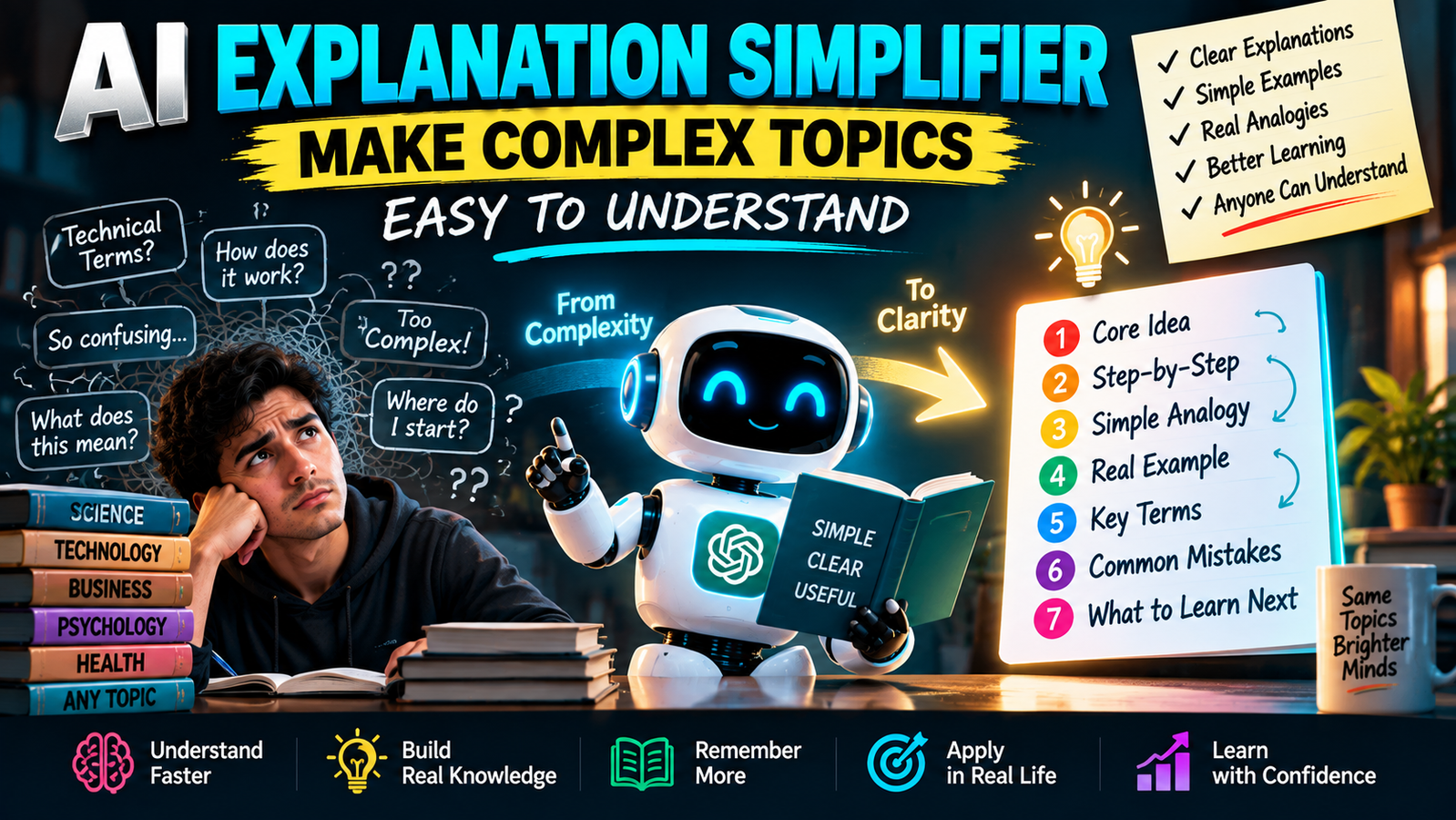
1. CORE IDEA
Explain the central concept in plain language.

2. BUILD THE FOUNDATION
Introduce only the background knowledge needed to understand it.

3. STEP-BY-STEP EXPLANATION
Break the concept into logical stages and explain how the parts connect.

4. SIMPLE ANALOGY
Give one accurate everyday analogy that makes the concept easier to visualize. Clearly explain where the analogy stops being accurate.

5. PRACTICAL EXAMPLE
Give one concrete example showing how the concept works.

6. KEY TERMS
Define only the important terms needed to understand the topic.

7. COMMON MISCONCEPTIONS
Identify 3 likely misunderstandings and correct them.

8. QUICK CHECK
Ask 3 short questions that test whether I actually understood the concept.

9. NEXT LEVEL
Suggest what I should learn next if I want a deeper understanding.

Rules:
- Prioritize clarity over jargon.
- Do not remove important details merely to make the explanation shorter.
- Introduce technical terminology only when useful and define it immediately.
- Do not assume knowledge that the learner has not stated.
- Use examples where they genuinely improve understanding.
- If the topic is uncertain, ambiguous, or context-dependent, say so clearly.
- Keep the explanation structured, practical, and easy to follow.
One Small Change Can Improve the Result
If the first explanation still feels difficult, do not immediately ask for a completely new answer.
Tell the AI exactly where you got stuck.
For example:
“I understand everything until the part about training data. Explain only that section using a simpler example.”
This creates a much better learning loop.
You can move from the broad explanation to the difficult section without restarting from zero.
You Can Also Reverse the Process
The same prompt can help when you know a subject but struggle to explain it to someone else.
Change the learner level and goal.
For example:
Learner Level: Complete beginner
Goal: Explain this concept to a customer in two minutes.
Now AI has a different job.
It is not teaching you. It is helping you construct an explanation appropriate for another person.
That makes the prompt useful for students, teachers, creators, managers, developers, writers, and anyone who regularly has to explain unfamiliar ideas.
The Best Explanations Build a Mental Model
A good explanation should leave you with more than a definition.
You should have some sense of:
What it is → how it works → why it matters → what it looks like in practice → what people commonly misunderstand.
That structure gives the learner something they can work with.
Once you have that mental model, additional technical detail becomes much easier to absorb.
The goal of this prompt is therefore not to make every subject “easy.”
It is to make the path toward understanding much clearer.