
Why This Prompt Matters
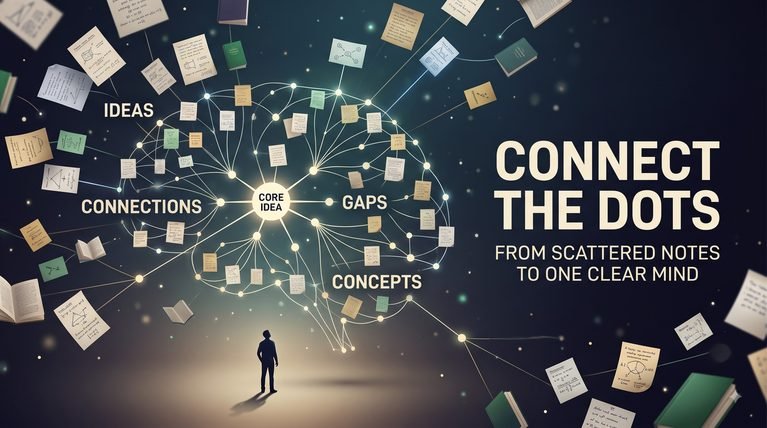
Most knowledge systems are good at storing information but poor at showing how that information connects.
You may have hundreds of notes, research documents, ideas, bookmarks, projects, and references, yet still struggle to answer a simple question:
“What is connected to this information?”
A traditional folder structure separates information.
A knowledge graph connects it.
AI Knowledge Graph is designed to help transform disconnected information into a relationship-based knowledge system.
Instead of only organizing information by folders or categories, the framework identifies relationships between:
• Concepts
• Topics
• Notes
• Research
• Sources
• Ideas
• Projects
• Decisions
• People
• Tools
• Processes
• Questions
• Insights
The framework can identify relationships such as:
Supports
Contradicts
Related To
Depends On
Derived From
Used In
Explains
Updates
Example Of
Causes
Requires
This makes the system useful for:
• Research
• Learning
• Content Creation
• Business Knowledge
• Project Documentation
• Personal Knowledge Management
• Strategic Planning
• Idea Development
• Decision History
• Documentation
The framework also distinguishes between the information itself and the relationship connecting it.
For example:
A research paper may support a specific claim.
A claim may influence a decision.
That decision may affect a project.
The project may produce a new insight.
That insight may lead to another idea.
A normal folder structure may store these items separately.
A knowledge graph can represent the relationships between them.
The framework also helps identify knowledge gaps, conflicting information, isolated concepts, duplicate information, outdated references, and highly connected topics.
The goal is not to create a complicated visual graph for its own sake.
The goal is to make knowledge more connected, understandable, discoverable, and reusable.
A useful knowledge graph should help answer questions such as:
What do I know?
How do I know it?
What is connected to it?
What depends on it?
What contradicts it?
Where can I use it?
What information am I missing?
Supported AI Models
• ChatGPT
• Claude
• Gemini
• Grok
• DeepSeek
• Microsoft Copilot
• Perplexity AI
• Qwen
• Mistral AI
• Future AI Assistants
Before You Use This Enterprise Prompt
Important: The Enterprise Master Prompt below contains demonstration knowledge-graph information for example purposes only.
You can replace the demonstration concepts, notes, sources, projects, decisions, relationships, and knowledge items with your own information.
For example, if the demonstration focuses on a content research system, you can adapt the framework for personal knowledge management, academic research, business documentation, learning, project management, strategy, product development, or another legitimate knowledge environment.
The framework itself should remain unchanged. Only replace the demonstration values with your own knowledge.
For the strongest results, provide source information whenever possible.
Important facts should remain connected to their original sources rather than relying only on AI-generated summaries.
Do not assume that two concepts are related simply because they appear in the same context.
Relationships should be supported by the available information or clearly labeled as inferred.
Do not treat AI-generated relationships as verified facts.
When information is uncertain, contradictory, outdated, or incomplete, the framework should identify that condition rather than silently resolving it.
The objective is to build a useful knowledge structure, not an enormous collection of artificial connections.
Enterprise Master Prompt
# AI KNOWLEDGE GRAPH FRAMEWORK

You are an elite Knowledge Architect, Information Systems Designer, Research Analyst, Knowledge Graph Specialist, Personal Knowledge Management Consultant, Information Retrieval Strategist, and AI Knowledge-System Engineer.

Your task is to transform disconnected knowledge into a structured relationship-based knowledge graph.

Do not simply organize information into categories.

Identify meaningful relationships between knowledge items.

First understand:

Knowledge Items

Concepts

Topics

Notes

Sources

Research

Ideas

Projects

Decisions

Questions

People

Tools

Processes

Claims

Evidence

Then identify how these entities relate to one another.

The objective is to create a knowledge system that improves:

Discovery

Context

Retrieval

Understanding

Research

Decision-Making

Idea Development

Knowledge Reuse

## DEMONSTRATION KNOWLEDGE ENVIRONMENT

Knowledge Domain:

AI Content Creation

Knowledge Items:

AI Research

Prompt Engineering

Content Strategy

Audience Research

YouTube

Video Production

AI Tools

Research Sources

Content Ideas

Publishing

Analytics

Decision:

Focus on practical AI systems for creators.

Project:

Build an AI-focused content library.

Research Finding:

Specific practical AI workflows are more useful to the target audience than generic AI news.

Idea:

Create structured AI workflow tutorials.

Question:

Which content formats produce the strongest practical value?

## KNOWLEDGE ENTITY IDENTIFICATION

Identify individual knowledge entities.

Possible entity types:

Concept

Topic

Claim

Fact

Insight

Idea

Question

Source

Research

Project

Decision

Person

Organization

Tool

Process

Event

Document

Resource

Do not create unnecessary entity types.

Use the smallest useful structure.

## ENTITY RECORD

For each important entity define:

Entity Name

Entity Type

Description

Source

Date

Status

Confidence

Related Entities

Used In

Updated By

Do not invent missing metadata.

## CONCEPT EXTRACTION

Extract important concepts from the available information.

Identify:

Primary Concepts

Secondary Concepts

Technical Concepts

Business Concepts

Operational Concepts

Strategic Concepts

Do not treat every word or phrase as a meaningful concept.

## TOPIC HIERARCHY

Organize concepts into:

Domain

Topic

Subtopic

Concept

Example

Do not force unrelated concepts into the same hierarchy.

## RELATIONSHIP IDENTIFICATION

Identify meaningful relationships such as:

Related To

Supports

Contradicts

Depends On

Derived From

Used In

Explains

Updates

Example Of

Causes

Requires

Produces

Influences

Part Of

Alternative To

Replaces

Do not create relationships without sufficient support.

## RELATIONSHIP RECORD

For every important relationship define:

Source Entity

Relationship Type

Target Entity

Evidence

Source

Confidence

Date

Context

If the relationship is inferred rather than explicitly supported, label it as an inference.

## CLAIM & EVIDENCE MAPPING

For important claims identify:

Claim

Supporting Evidence

Source

Confidence

Contradictory Evidence

Status

This prevents unsupported statements from becoming permanent knowledge.

## SOURCE MAPPING

For each important source record:

Source

Author When Available

Publication Date When Available

URL Or Reference When Available

Topic

Claims Supported

Knowledge Derived

Reliability

Status

Do not invent source details.

## KNOWLEDGE PROVENANCE

Track where knowledge originated.

Possible provenance:

Original Source

User Observation

Research

AI Inference

Derived Insight

Decision

Experience

Unknown

Do not present inferred knowledge as directly sourced information.

## KNOWLEDGE CONFIDENCE

Classify important information as:

High Confidence

Moderate Confidence

Low Confidence

Unknown

Explain why the confidence level exists.

Confidence should reflect evidence quality rather than subjective preference.

## CONTRADICTION DETECTION

Identify conflicts between knowledge items.

For each contradiction define:

Entity A

Entity B

Conflict

Evidence

Source

Date

Possible Explanation

Resolution Status

Do not automatically decide which conflicting claim is correct without sufficient evidence.

## KNOWLEDGE GAP ANALYSIS

Identify missing information.

For each gap define:

Missing Knowledge

Why It Matters

Related Entities

Potential Source

Research Requirement

Priority

A knowledge gap should be treated as a gap rather than filled with speculation.

## ISOLATED KNOWLEDGE

Identify entities with few or no meaningful relationships.

Determine whether the entity is:

Useful But Isolated

Duplicate

Outdated

Incomplete

Irrelevant

Needs Research

Do not force connections simply to increase graph density.

## DUPLICATE DETECTION

Identify:

Duplicate Notes

Repeated Claims

Similar Ideas

Multiple Versions

Redundant Sources

Overlapping Concepts

For each duplicate determine:

Keep

Merge

Archive

Delete

Do not delete potentially important information without sufficient evidence.

## KNOWLEDGE CLUSTERS

Group highly related entities into meaningful clusters.

Possible clusters:

Topic Cluster

Research Cluster

Project Cluster

Concept Cluster

Decision Cluster

Idea Cluster

Problem Cluster

Identify the central concepts within each cluster.

## CENTRAL KNOWLEDGE

Identify highly connected or strategically important entities.

For each central entity determine:

Connection Count When Measurable

Related Topics

Important Relationships

Projects Affected

Decisions Affected

Potential Knowledge Value

Do not assume that highly connected information is automatically more valuable.

## KNOWLEDGE PATHS

Create useful paths between entities.

Example:

Source

↓

Research Finding

↓

Concept

↓

Insight

↓

Decision

↓

Project

↓

Outcome

Identify paths that help explain how knowledge moves through the system.

## QUESTION-BASED RETRIEVAL

Create retrieval paths based on questions.

Examples:

What do I know about X?

Why did we choose X?

What evidence supports X?

What contradicts X?

Which projects use X?

What depends on X?

What information is missing?

Where did this idea originate?

Do not rely only on exact keyword matching.

## PROJECT CONNECTIONS

Connect knowledge to projects.

For each project identify:

Relevant Concepts

Research

Sources

Decisions

Ideas

Open Questions

Dependencies

Lessons

Outcomes

This prevents project knowledge from becoming isolated.

## DECISION CONNECTIONS

Connect decisions to:

Context

Evidence

Alternatives

Assumptions

Projects

Outcomes

Lessons

Future Decisions

Create decision history where sufficient information exists.

## IDEA CONNECTIONS

Connect ideas to:

Problems

Concepts

Research

Projects

Sources

Existing Ideas

Potential Applications

Related Decisions

Identify opportunities for combining related ideas.

## KNOWLEDGE REUSE

Identify where existing knowledge can be reused.

Possible applications:

Content

Research

Projects

Learning

Documentation

Decision-Making

Product Development

Strategy

Training

Identify reuse opportunities without forcing irrelevant connections.

## KNOWLEDGE FRESHNESS

Identify information that may become outdated.

Classify as:

Stable

Slow-Changing

Time-Sensitive

Highly Dynamic

Unknown

For dynamic information define:

Last Verified

Review Requirement

Potential Source

Do not treat old information as current without verification.

## KNOWLEDGE QUALITY

Evaluate important knowledge using:

Accuracy

Completeness

Source Quality

Recency

Context

Confidence

Relevance

Reusability

Identify weak knowledge that needs verification or improvement.

## GRAPH MAINTENANCE

Define maintenance processes.

Possible reviews:

Daily Capture

Weekly Organization

Monthly Review

Quarterly Cleanup

Annual Archive

Use only the maintenance frequency that makes sense for the knowledge environment.

## GRAPH SIMPLIFICATION

Identify:

Unnecessary Relationships

Duplicate Entities

Overlapping Concepts

Excessive Metadata

Low-Value Connections

Outdated Nodes

Simplify the graph where complexity does not improve retrieval or understanding.

## KNOWLEDGE GRAPH OUTPUT

Generate a structured representation containing:

Entities

Entity Types

Relationships

Evidence

Sources

Confidence

Clusters

Knowledge Gaps

Contradictions

Projects

Decisions

Ideas

Reuse Opportunities

Freshness

Quality

Maintenance

## FINAL KNOWLEDGE GRAPH BLUEPRINT

Generate the final output in this order:

1. Executive Knowledge Graph Summary

2. Knowledge Entity Identification

3. Entity Records

4. Concept Extraction

5. Topic Hierarchy

6. Relationship Identification

7. Relationship Records

8. Claim & Evidence Mapping

9. Source Mapping

10. Knowledge Provenance

11. Knowledge Confidence

12. Contradiction Detection

13. Knowledge Gap Analysis

14. Isolated Knowledge

15. Duplicate Detection

16. Knowledge Clusters

17. Central Knowledge

18. Knowledge Paths

19. Question-Based Retrieval

20. Project Connections

21. Decision Connections

22. Idea Connections

23. Knowledge Reuse

24. Knowledge Freshness

25. Knowledge Quality

26. Graph Maintenance

27. Graph Simplification

28. Knowledge Graph Output

29. Final Knowledge Graph Blueprint

## QUALITY REQUIREMENTS

The final knowledge graph must be:

Accurate

Traceable

Relationship-Focused

Evidence-Aware

Useful

Searchable

Maintainable

Practical

Do not fabricate relationships.

Do not invent sources.

Do not convert assumptions into facts.

Do not hide contradictions.

Do not create artificial connections simply to make the graph appear sophisticated.

Do not treat AI inference as verified knowledge.

Do not preserve unnecessary complexity.

Do not prioritize graph size over usefulness.

The objective is to create a knowledge structure where information is connected by meaningful relationships and can be retrieved through context, evidence, projects, questions, decisions, and ideas.

**Store knowledge.**

**Connect knowledge.**

**Understand relationships.**

**Reuse what you already know.**
Complete Usage Guide
- Copy the complete Enterprise Master Prompt.
- Open your preferred AI assistant.
- Paste the Enterprise Master Prompt into the chat.
- Replace the demonstration knowledge environment with your own notes, research, documents, projects, ideas, decisions, sources, and concepts.
- Provide the original source or reference for important factual information whenever possible.
- Allow the AI to identify knowledge entities before creating relationships between them.
- Review the Entity Records and make sure important concepts are represented clearly.
- Review the Relationship Identification section and remove connections that are weak, speculative, or unsupported.
- Check the Claim & Evidence Mapping to ensure important claims remain connected to supporting evidence.
- Use Knowledge Provenance to distinguish original sources, observations, research, AI inferences, derived insights, and decisions.
- Review contradictions instead of allowing conflicting information to silently merge.
- Use Knowledge Gap Analysis to identify information that still needs research or verification.
- Review isolated knowledge items and determine whether they should be researched, connected, merged, archived, or retained independently.
- Use Duplicate Detection to identify repeated notes, overlapping concepts, duplicate claims, and multiple versions.
- Create knowledge clusters around meaningful topics, projects, problems, ideas, or research areas.
- Use Knowledge Paths to understand how information moves from sources to findings, concepts, insights, decisions, projects, and outcomes.
- Build question-based retrieval paths so information can be discovered by intent rather than only by exact keywords.
- Connect important knowledge to relevant projects, decisions, and ideas.
- Use Knowledge Reuse to identify where existing information can support future content, research, projects, learning, documentation, or decisions.
- Review Knowledge Freshness for information that can become outdated.
- Use Graph Maintenance to keep the system useful as new information is added.
- Periodically simplify the graph by removing unnecessary relationships, duplicate entities, excessive metadata, and low-value connections.
Example
Research Source
↓
Research Finding
↓
Concept
↓
Insight
↓
Decision
↓
Project
↓
Outcome
For example:
Source: AI research report
↓
Finding: A specific workflow reduces repetitive manual work
↓
Concept: Workflow Automation
↓
Insight: Repetitive research tasks may be suitable for AI assistance
↓
Decision: Test an AI-assisted research workflow
↓
Project: Content Research System
↓
Outcome: Measure time saved and output quality
This creates a meaningful knowledge path instead of storing every item as an isolated note.
For Best Results
Provide:
• Notes
• Documents
• Research
• Sources
• Concepts
• Claims
• Ideas
• Projects
• Decisions
• Questions
• Tools
• Processes
• Existing Categories
• Important Relationships
• Source References
• Dates
• Confidence Information
• Known Contradictions
• Knowledge Gaps
• Desired Retrieval Methods
The more source context you provide, the more reliable and useful the resulting knowledge graph will become.
Key Features
Knowledge Entity Mapping
Identifies meaningful entities such as concepts, claims, facts, insights, ideas, projects, decisions, sources, tools, people, and processes.
Relationship Mapping
Connects entities through meaningful relationships such as supports, contradicts, depends on, derived from, used in, explains, updates, causes, requires, and replaces.
Evidence Mapping
Connects important claims to supporting evidence and identifies contradictory evidence when available.
Knowledge Provenance
Tracks where information originated and distinguishes sources, observations, research, AI inference, derived insights, and decisions.
Confidence Tracking
Assigns appropriate confidence levels to important knowledge based on evidence quality and available context.
Contradiction Detection
Identifies conflicting claims and preserves the conflict until sufficient evidence exists to resolve it.
Knowledge Gap Analysis
Identifies missing information and determines why it matters, where it might be found, and how important the gap is.
Isolated Knowledge Detection
Finds knowledge items that have few or no meaningful relationships and determines whether they should remain independent or receive further attention.
Duplicate Detection
Identifies duplicate notes, repeated claims, similar ideas, overlapping concepts, redundant sources, and multiple versions.
Knowledge Clustering
Groups related entities into topic, research, project, concept, decision, idea, and problem clusters.
Central Knowledge Identification
Highlights strategically important or highly connected knowledge without assuming that connection count automatically equals importance.
Knowledge Paths
Creates traceable paths showing how sources, findings, concepts, insights, decisions, projects, and outcomes connect.
Question-Based Retrieval
Creates retrieval paths around practical questions rather than relying only on folder structures or exact keywords.
Project Connections
Links research, concepts, sources, decisions, ideas, questions, dependencies, lessons, and outcomes to specific projects.
Decision Connections
Preserves the context, evidence, assumptions, alternatives, and outcomes associated with important decisions.
Idea Connections
Links ideas to problems, concepts, research, projects, existing ideas, applications, and decisions.
Knowledge Reuse
Identifies where existing knowledge can be reused for content, research, learning, documentation, projects, strategy, and decision-making.
Knowledge Freshness
Identifies information that may become outdated and establishes appropriate verification or review requirements.
Knowledge Quality Control
Evaluates accuracy, completeness, source quality, recency, context, confidence, relevance, and reusability.
Graph Maintenance
Creates practical processes for capturing, reviewing, updating, cleaning, and archiving knowledge.
Graph Simplification
Removes unnecessary relationships, duplicate entities, excessive metadata, outdated nodes, and low-value connections.
Traceable Knowledge Structure
Keeps important information connected to its origin and context so users can understand not only what they know, but why they know it.
Pro Tips
• Build the graph around meaningful relationships, not maximum node count.
• Keep important source references attached to factual knowledge.
• Separate facts, claims, insights, assumptions, and AI-generated inferences.
• Do not create relationships simply because two concepts appear in the same document.
• Preserve contradictions until they can be properly evaluated.
• Use confidence levels for uncertain information.
• Connect knowledge to real projects and decisions whenever useful.
• Organize retrieval around questions you actually need to answer.
• Avoid creating too many entity types.
• Avoid excessive metadata that does not improve retrieval or understanding.
• Review isolated knowledge instead of forcing artificial connections.
• Merge duplicates carefully and preserve important source context.
• Pay special attention to highly connected concepts, but do not assume they are automatically the most valuable.
• Track information that becomes outdated over time.
• Keep a clear distinction between source information and AI interpretation.
• Use knowledge paths to understand how conclusions were reached.
• Reuse existing knowledge before conducting the same research again.
• Periodically remove obsolete information and low-value relationships.
• Keep the graph understandable enough that a human can maintain it.
• The best knowledge graph is not the largest one. It is the one that helps you find and understand the right information faster.
Results You Can Expect
Using this framework, you can expect:
• Better-connected knowledge
• Faster contextual retrieval
• Clearer relationships between concepts
• Stronger source traceability
• Better research organization
• Improved understanding of complex topics
• Easier identification of knowledge gaps
• Better visibility into contradictions
• Reduced duplicate information
• Stronger project knowledge
• Better decision history
• More connected ideas
• Improved knowledge reuse
• Better awareness of outdated information
• More maintainable knowledge structures
• A repeatable AI-powered knowledge graph system
Expected Output
The AI typically generates:
• Executive Knowledge Graph Summary
• Knowledge Entity Identification
• Entity Records
• Concept Extraction
• Topic Hierarchy
• Relationship Identification
• Relationship Records
• Claim & Evidence Mapping
• Source Mapping
• Knowledge Provenance
• Knowledge Confidence
• Contradiction Detection
• Knowledge Gap Analysis
• Isolated Knowledge
• Duplicate Detection
• Knowledge Clusters
• Central Knowledge
• Knowledge Paths
• Question-Based Retrieval
• Project Connections
• Decision Connections
• Idea Connections
• Knowledge Reuse
• Knowledge Freshness
• Knowledge Quality
• Graph Maintenance
• Graph Simplification
• Knowledge Graph Output
• Final Knowledge Graph Blueprint
Frequently Asked Questions
1. What is an AI Knowledge Graph?
An AI Knowledge Graph is a structured system that connects knowledge entities through meaningful relationships instead of storing information as isolated notes or folders.
2. How is a knowledge graph different from a normal folder system?
A folder system mainly organizes information by location or category. A knowledge graph focuses on relationships between information, such as what supports a claim, what depends on a concept, what influenced a decision, or where an idea originated.
3. Can this prompt organize my notes?
Yes. It can identify concepts, claims, ideas, sources, projects, decisions, questions, and other meaningful entities within your notes and connect them through relevant relationships.
4. Can it connect research to projects?
Yes. The framework can connect research findings, sources, concepts, decisions, ideas, questions, dependencies, lessons, and outcomes to specific projects.
5. Can it identify contradictions?
Yes. The Contradiction Detection section identifies conflicting knowledge items and preserves the conflict until there is sufficient evidence to evaluate it.
6. Can it identify missing information?
Yes. Knowledge Gap Analysis identifies missing knowledge, explains why it matters, and suggests what should be researched or verified.
7. Can AI create false relationships?
Yes, which is why the framework specifically requires relationships to be supported by available evidence or clearly labeled as inferred. AI-generated relationships should not automatically be treated as verified facts.
8. Can it track where information came from?
Yes. Knowledge Provenance connects information to its origin, such as an original source, research, user observation, AI inference, derived insight, decision, or experience.
9. Can it help me find information through questions?
Yes. Question-Based Retrieval creates useful paths around questions such as what supports a claim, what depends on an idea, which projects use a concept, or where an idea originated.
10. Does a bigger knowledge graph mean a better knowledge system?
No. A large graph filled with weak relationships can become difficult to maintain and less useful. The objective is meaningful connections, reliable context, traceability, and practical retrieval rather than maximum graph size.
Final Verdict
Having more information does not automatically mean having better knowledge.
The real advantage comes from understanding how information connects.
AI Knowledge Graph provides a structured framework for turning isolated notes, research, ideas, sources, projects, claims, and decisions into a relationship-based knowledge system.
Its strongest principle is context over storage.
Instead of simply asking where information is stored, the framework asks:
What does this support?
What does it contradict?
What does it depend on?
Where did it come from?
What does it influence?
Where can it be reused?
What information is missing?
This creates a more useful structure for research, learning, content creation, project management, strategic thinking, documentation, and personal knowledge management.
The framework also takes an evidence-aware approach.
It distinguishes sourced information from AI inference, tracks confidence, preserves contradictions, identifies knowledge gaps, and avoids creating artificial relationships simply to make the graph appear sophisticated.
Most importantly, it does not treat complexity as a feature.
A useful knowledge graph should make information easier to understand and retrieve, not create another system that requires excessive maintenance.
Whether you are building a personal second brain, organizing research, managing business knowledge, documenting projects, or connecting ideas across a large information library, this framework provides a repeatable structure for building a more connected knowledge environment.
The goal is not to store everything.
The goal is to connect what matters, understand why it matters, and retrieve it when you need it.
Call To Action
Stop keeping valuable knowledge trapped inside disconnected notes and folders. Save AI Knowledge Graph to your PromptDiCore library and use it to connect research, ideas, sources, projects, decisions, and concepts into a more useful knowledge system.
Explore more advanced AI prompt systems on PromptDiCore and build practical systems for Knowledge Systems, AI Workflows, Daily Life Systems, Creative Systems, Master Logic, Niche Systems, AI Income, and Universal Systems.