Learning something new can become surprisingly inefficient when you do not know what you are missing.
You read an article, watch a few videos, take notes, and move on to another resource. You may even feel like you are making progress.
Then you try to apply the knowledge and discover a problem.
You understand the individual pieces, but something is still missing.
That missing piece is often a knowledge gap.
A knowledge gap is the difference between what you currently understand and what you need to understand to accomplish a particular goal.
Finding that gap can be more useful than simply consuming more information.
Start With the Goal
A learning plan should begin with the outcome, not the number of courses or books you want to finish.
Suppose your goal is:
“I want to build a simple website.”
That goal immediately gives your learning process some direction.
You may need to understand HTML, CSS, basic JavaScript, deployment, domains, and perhaps a little version control.
But you probably do not need to study every concept in web development before building anything.
Now change the goal:
“I want to become a professional frontend developer.”
The required knowledge becomes much broader.
The gap depends on where you are trying to go.
Why Random Learning Can Waste Time
Imagine someone already understands basic Python but keeps watching beginner programming tutorials.
They are learning, but not necessarily progressing toward their goal.
The problem is not lack of effort.
It is lack of diagnosis.
A knowledge-gap analysis can reveal that the learner would benefit more from studying data structures, testing, APIs, databases, or software architecture.
Instead of asking:
“What should I learn about this subject?”
you can ask:
“What am I missing for the outcome I want?”
That is a much narrower and more useful question.
What This Prompt Examines
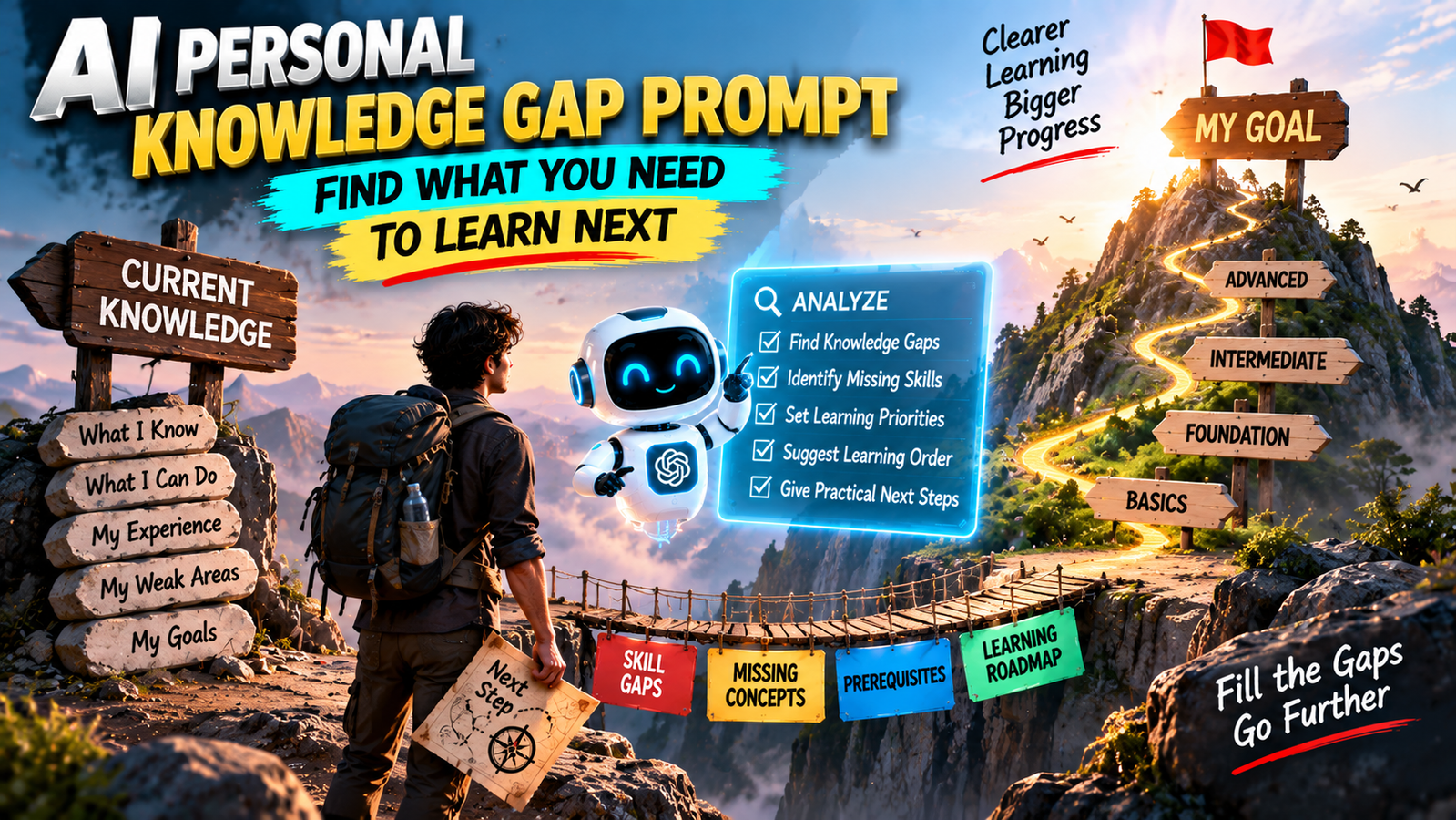
The prompt compares your current knowledge with your target outcome.
It looks for:
- Concepts you already understand
- Important concepts you may be missing
- Skills that need strengthening
- Prerequisites you have overlooked
- Areas where your understanding may be superficial
- Knowledge that is useful but not currently necessary
- The order in which missing pieces should be learned
This creates a learning path based on your actual starting point.
You Do Not Need to Know What You Do Not Know
That sounds obvious, but it is one of the hardest parts of learning.
If you already knew exactly what you were missing, you would not have a knowledge gap in that area.
For example, a beginner learning SEO may know about keywords and titles but have no idea that technical SEO, indexing, search intent, internal linking, structured data, and site architecture are separate areas.
An AI analysis can help expose those blind spots.
It does not replace proper study or expert instruction, but it can give you a useful map of what to investigate.
Tell AI What You Already Know
This is one of the most important inputs.
Do not simply write:
“I know some marketing.”
Be more specific:
“I understand basic keyword research, content writing, and social media promotion, but I have never worked with analytics or conversion tracking.”
Now the analysis has a starting point.
The result can focus on the difference between your current knowledge and the skills required for your goal.
Prioritize the Gaps
Not every missing concept deserves immediate attention.
Some gaps are foundational.
Others are advanced topics that can wait.
For example, if you are learning programming and do not understand variables or functions, jumping immediately into software architecture is probably premature.
The prompt therefore asks AI to classify learning gaps according to their importance and dependency.
This helps prevent a common problem:
studying advanced topics before mastering the foundation they depend on.
A Practical Example
Imagine your goal is:
“I want to create and manage a small online store.”
You already know:
- Basic product research
- Social media posting
- Simple website editing
But you have little experience with:
- Payment systems
- Product-page optimization
- Analytics
- Customer retention
- Inventory management
A generic learning plan might give you dozens of unrelated subjects.
A knowledge-gap analysis can instead organize the missing areas around the actual goal.
It might identify payment setup and basic store operations as immediate priorities, while advanced retention strategies can come later.
That makes the learning process much more focused.
Use It When You Feel Stuck
This prompt is particularly useful when you have been learning something for a while but cannot explain why progress has slowed down.
Sometimes the problem is not motivation.
You may simply be missing a prerequisite.
For example, a person struggling with advanced Excel formulas may actually have gaps in basic data organization.
Someone struggling with statistics may be missing foundational probability concepts.
Someone struggling to write persuasive copy may understand writing mechanics but lack knowledge of audience research and positioning.
Finding the missing foundation can make the next stage much easier.
MASTER PROMPT — COPY & PASTE
Act as a learning diagnostician and knowledge-gap analyst.

MY LEARNING GOAL:
[Describe exactly what I want to be able to do]

MY CURRENT KNOWLEDGE:
[Describe what I already understand or can do]

MY EXPERIENCE:
[Beginner / Intermediate / Advanced, plus relevant experience]

KNOWN WEAK AREAS:
[Optional: areas I already know I struggle with]

Analyze the gap between my current ability and my target outcome.

Provide:

1. CURRENT KNOWLEDGE
Summarize what I already appear to understand based only on the information provided.

2. KNOWLEDGE GAPS
Identify important concepts, skills, or abilities I may be missing.

3. SKILL GAPS
Separate knowledge I need to understand from practical skills I need to develop.

4. PREREQUISITES
Identify foundational topics that should be learned before more advanced areas.

5. PRIORITY
Rank the gaps as High, Medium, or Low priority based on their importance to my stated goal.

6. LEARNING ORDER
Create a logical sequence showing what I should learn first, next, and later.

7. UNNECESSARY LEARNING
Identify topics that may be interesting but are not currently necessary for my goal.

8. BLIND SPOTS
Identify areas I may be overlooking because they are not obvious from my current understanding.

9. PRACTICAL TEST
For each high-priority gap, suggest a small practical exercise that could reveal whether I actually understand it.

10. NEXT STEP
Tell me the single most useful thing to learn or practice next.

Rules:
- Do not assume I know something unless my information supports it.
- Do not invent experience, skills, or weaknesses.
- Clearly distinguish confirmed knowledge from possible gaps.
- Do not create an unnecessarily large curriculum.
- Prioritize what directly supports my stated goal.
- Explain dependencies when one topic should be learned before another.
- If there is not enough information to judge a gap confidently, say so.
Test Your Knowledge Instead of Trusting the List
A list of topics is not proof that you have a knowledge gap.
That is why the practical tests in the prompt matter.
Suppose AI says you need to understand customer segmentation.
Instead of immediately watching five hours of content, try explaining:
Who are the different groups of customers for this product, and why would their needs differ?
If you can answer confidently and accurately, the gap may be smaller than expected.
If you struggle, you have identified something worth studying.
That turns learning into diagnosis rather than endless consumption.
Keep Your Learning Narrow
A common mistake is trying to close every gap simultaneously.
That creates another problem: too much information.
Choose one or two high-priority gaps and work on them first.
Once they are stronger, run the analysis again.
Your knowledge map will change as you learn.
That is a good thing.
The goal is not to create a permanent checklist.
It is to keep discovering the next useful gap.
Knowledge Is Not the Same as Ability
You can understand a concept without being able to use it.
That distinction matters.
Someone might understand how budgeting works but still struggle to build a workable personal budget.
Someone might understand programming concepts but struggle to build a functioning application.
Someone might understand marketing theory but have difficulty creating a campaign.
That is why the prompt separates knowledge gaps from skill gaps.
Knowing what something means is different from being able to do it.
Build a Learning Loop
You can use the prompt repeatedly as your skills develop:
Goal → Current Knowledge → Gap Analysis → Learn → Practice → Reassess
This prevents your learning plan from becoming outdated.
Instead of asking AI to create a massive curriculum once, you use it as a diagnostic tool throughout the process.
The result is a more focused approach to learning.
You are not trying to know everything.
You are trying to identify what matters next, learn it properly, and then reassess where the next gap is.