A good interview answer is not always about having an impressive story.
Often, the story is already there.
The problem is explaining it clearly.
You may have solved a difficult problem at work, handled an unhappy customer, improved a process, learned from a mistake, or completed a project under pressure. But when an interviewer asks, “Tell me about a time when you faced a challenge,” it can be surprisingly difficult to turn that experience into a concise answer.
You remember what happened.
You just do not know how to organize it.
That is where this prompt can help.
Why Interview Stories Matter
Behavioral interview questions are usually looking for evidence of how you have handled real situations.
An interviewer may ask:
- Tell me about a difficult problem you solved.
- Describe a time you made a mistake.
- Tell me about a conflict with a colleague.
- Give an example of when you took initiative.
- Describe a situation where you had to work under pressure.
A weak answer can become a long story with too much background and not enough substance.
A stronger answer makes the situation easy to understand, explains what you personally did, and shows what happened as a result.
The STAR Structure Helps, But It Should Not Sound Robotic
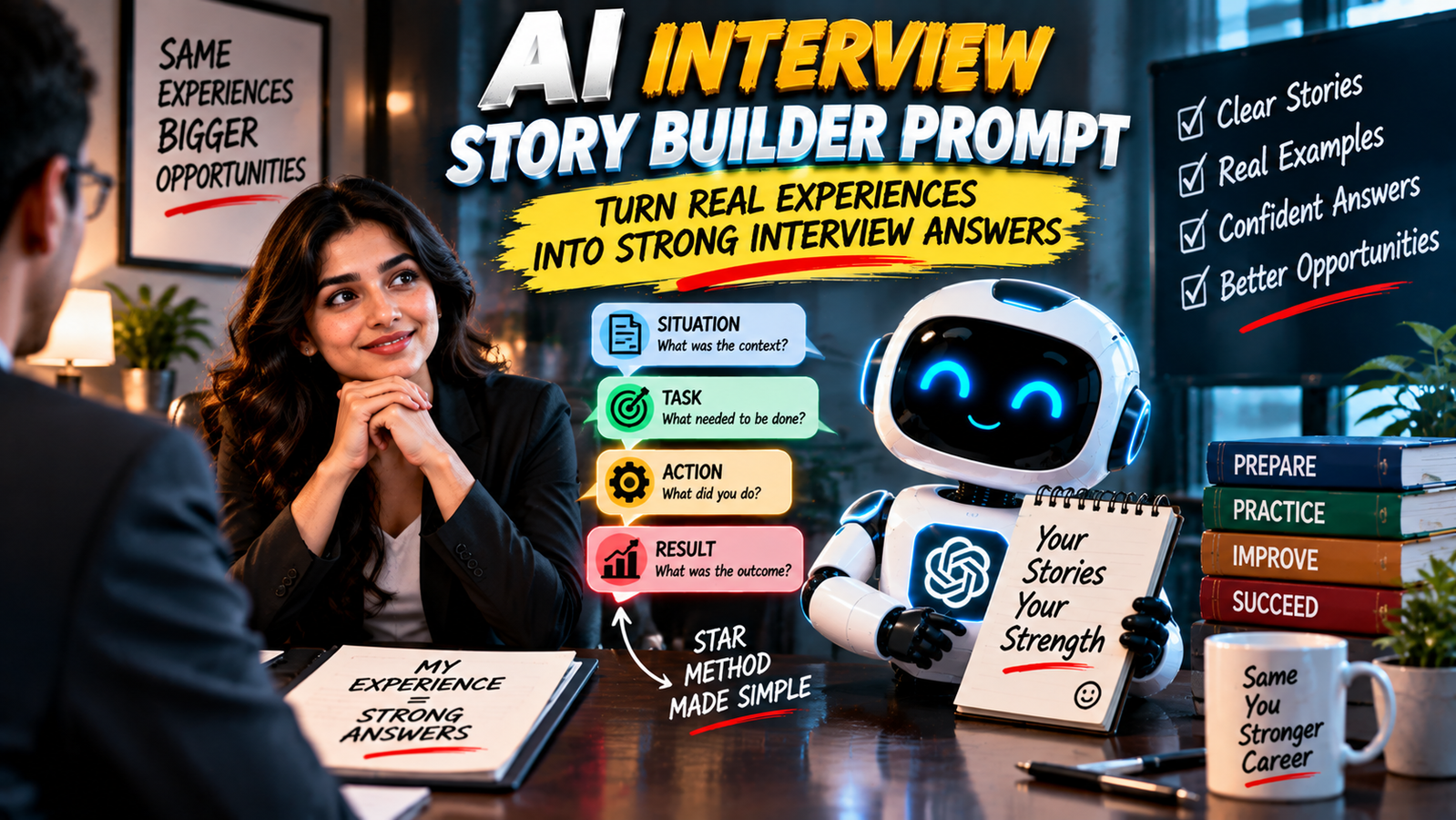
The STAR framework is commonly used to organize behavioral interview answers:
Situation → Task → Action → Result
It provides a useful structure.
But there is a potential problem.
If every answer sounds like it was generated from a rigid template, the response can feel rehearsed.
The better approach is to use the structure underneath the answer while keeping the actual language natural.
That is why this prompt first analyzes your real experience and then turns it into a conversational response.
Start With Something You Actually Did
The strongest input is usually a real experience, even if it seems ordinary.
For example:
“A client was unhappy because a project was delayed. I reviewed the timeline, found that the delay came from missing information at the beginning, explained the issue to the client, and reorganized the remaining work so we could finish faster.”
That may not sound like a polished interview answer yet.
But it contains useful material:
- A problem
- Your involvement
- A decision
- An action
- A result
- A lesson about preventing similar delays
The prompt helps turn those raw details into a coherent story.
Do Not Invent Achievements
This is one of the most important rules.
If you did not increase revenue by 40%, do not let AI add that number.
If you did not manage a team of ten people, do not let the answer imply that you did.
If there was no measurable result, the answer can simply explain the practical outcome.
A credible answer based on a real experience is much better than an impressive-sounding story that you cannot defend in a follow-up question.
What the Prompt Looks For
The analysis focuses on the parts of your experience that matter in an interview.
It identifies:
- The actual challenge
- Your responsibility
- The actions you personally took
- The reasoning behind those actions
- The outcome
- Skills demonstrated
- What could be explained more clearly
- Details that should not be exaggerated
It can also suggest likely follow-up questions.
That gives you a chance to prepare beyond the first answer.
Turn Ordinary Experiences Into Useful Stories
Not every interview story needs to involve a dramatic crisis.
Consider something as simple as improving a repetitive process.
Perhaps your team manually prepared a report every week.
You noticed that some of the work was repeated, created a standardized template, reorganized the information, and reduced the preparation time.
That can demonstrate:
- Initiative
- Problem solving
- Process improvement
- Attention to detail
- Efficiency
The story becomes valuable because of what you did and why you did it.
One Experience Can Answer Several Questions
A useful interview story can often be adapted to different behavioral questions.
The same project might demonstrate:
Problem solving: You identified and fixed an issue.
Initiative: You acted without waiting to be told.
Teamwork: You coordinated with others.
Adaptability: You changed your approach when circumstances changed.
The prompt can identify these different angles.
That makes your preparation more efficient.
Keep the Final Answer Natural
Do not memorize every sentence word for word.
Instead, understand the structure and key points.
You should be able to explain:
What happened → what I needed to do → what I actually did → what happened afterward → what I learned.
Then speak naturally.
That sounds much more authentic than reciting a perfectly polished paragraph.
Add the Missing Details
If your experience is too vague, the prompt can tell you what information would strengthen it.
For example, if you say:
“I solved a customer problem.”
That is not enough.
The useful follow-up questions might be:
What was the problem?
What did you personally do?
Why did you choose that approach?
What changed afterward?
What did you learn?
You can answer those questions before generating the final version.
MASTER PROMPT — COPY & PASTE
Act as an interview preparation coach and behavioral-story editor.

I will provide a real experience from my work, education, projects, volunteering, or personal responsibilities.

MY EXPERIENCE:
[Describe what happened in your own words]

TARGET ROLE:
[Enter the role you are applying for]

QUESTION TYPE:
[Example: leadership, teamwork, conflict, failure, problem solving, initiative, adaptability]

Analyze my experience and turn it into a strong, natural interview answer.

Use the following process:

1. CORE STORY
Identify the central situation and the actual challenge.

2. MY ROLE
Clearly separate what I personally did from what other people did.

3. STAR STRUCTURE
Organize the experience into Situation, Task, Action, and Result.

4. STRONGEST EVIDENCE
Identify the details that best demonstrate the skill being tested.

5. MISSING DETAILS
List important information that would improve the answer. Ask questions only where the missing information could materially strengthen the story.

6. INTERVIEW ANSWER
Write a concise, conversational answer that sounds like a real person speaking, not a memorized script.

7. SKILL SIGNALS
Identify the skills or qualities demonstrated by the story.

8. FOLLOW-UP QUESTIONS
Generate 5 realistic questions an interviewer might ask after hearing this answer.

9. FOLLOW-UP PREPARATION
Give brief guidance on what each follow-up answer should address, using only information supported by my experience.

10. ALTERNATIVE ANGLES
Show how the same experience could be adapted for 3 different behavioral interview questions.

Rules:
- Never invent achievements, numbers, responsibilities, employers, outcomes, or details.
- Never exaggerate my contribution.
- Clearly identify information that is missing.
- Keep the final answer natural and conversational.
- Prefer specific evidence over generic claims.
- Keep unnecessary background out of the final answer.
- Preserve my actual experience and voice rather than making the answer sound artificial.
Practice the Follow-Up Questions
This is where many prepared answers break down.
Someone may have a polished response for:
“Tell me about a challenge you faced.”
But then the interviewer asks:
“Why did you choose that approach?”
If you cannot explain the reasoning behind your action, the original answer becomes much less convincing.
That is why preparing the follow-up questions can be just as important as preparing the main response.
Focus on Your Actions
Another common mistake is spending too much time describing what the team did.
An interviewer usually needs to understand your contribution.
Compare:
“We worked together and solved the problem.”
with:
“I reviewed the process, identified the missing step, and proposed a revised workflow that the team then adopted.”
The second makes your role much clearer.
You should still give credit to other people when appropriate, but do not hide your own contribution inside the word “we.”
Results Do Not Always Need a Number
A measurable result is useful when you genuinely have one.
But not every experience has a precise metric.
You can still describe a real outcome:
- The issue was resolved
- The client accepted the revised plan
- The process became easier to manage
- The team avoided repeating the problem
- The project was completed successfully
- You learned a lesson that changed how you approached later work
The important thing is accuracy.
Do not manufacture statistics just to make the story sound stronger.
Build a Small Story Bank
Instead of preparing a completely different story for every possible question, collect several genuine experiences.
For example:
Story 1: Difficult problem
Story 2: Team conflict
Story 3: Process improvement
Story 4: Mistake and recovery
Story 5: Taking initiative
Story 6: Working under pressure
Then use the prompt to identify which interview questions each story can support.
This creates a flexible preparation system rather than a collection of memorized answers.
Your Experience Is the Raw Material
AI can improve structure, clarity, and preparation.
It cannot replace the underlying experience.
The strongest interview answers usually come from something you genuinely did, clearly explained.
So before worrying about perfect wording, ask yourself:
What actually happened?
What did I personally do?
Why did I do it?
What changed because of my actions?
Once those details are clear, turning the experience into a strong interview story becomes much easier.