Running out of content ideas does not always mean you have run out of topics.
Often, you are simply looking at the same topic from the same direction.
Take something as broad as remote work. You could create another basic article about its benefits, but that is only one possible angle.
The same topic could become a guide for managers, a comparison of remote and hybrid work, a list of common mistakes, a productivity experiment, a beginner’s checklist, a case analysis, or even a contrarian discussion about when remote work fails.
The subject stayed the same.
The perspective changed.
That is what this prompt is designed to help you find.
One Topic Can Produce Many Different Stories
A useful content strategy does not always require discovering a completely new subject.
Instead, you can take an existing topic and ask different questions around it.
For example, consider:
Topic: AI for small businesses
Possible angles include:
- What beginners misunderstand about AI
- The first five tasks a small business should automate
- Where AI creates unnecessary complexity
- AI mistakes that cost businesses time
- A comparison between manual and AI-assisted workflows
- How a non-technical owner can start using AI
- Situations where AI should not be used
Each idea speaks about the same general subject, but each one gives the audience a different reason to pay attention.
What This Prompt Finds
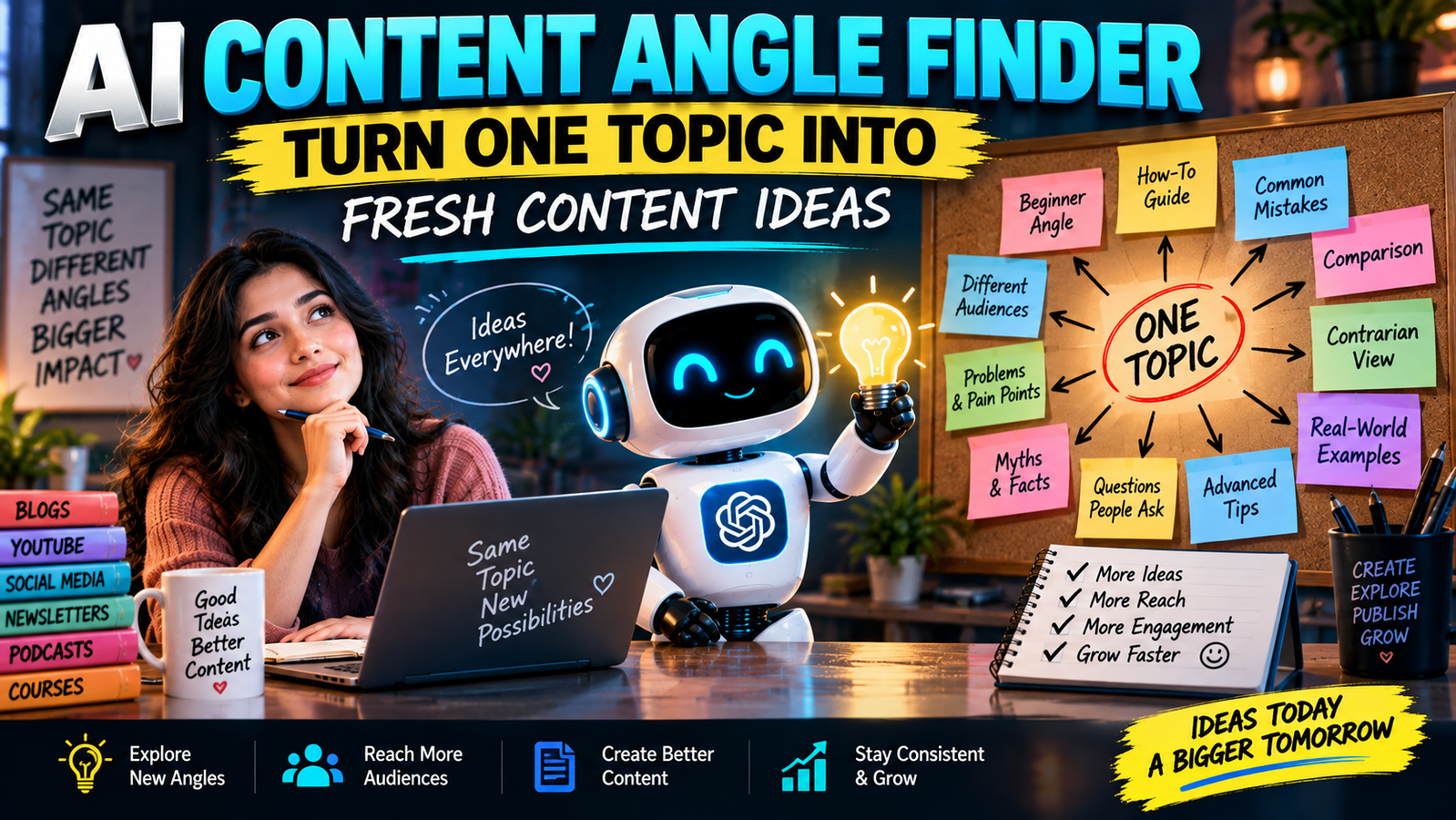
Instead of producing a random list of titles, the prompt explores several dimensions of a topic.
It considers:
- Audience perspective
- Problems and pain points
- Common mistakes
- Contrarian viewpoints
- Practical applications
- Comparisons
- Questions people may have
- Beginner and advanced perspectives
- Storytelling opportunities
- Different content formats
This gives you a wider creative field to work with.
Useful When Your Niche Feels Repetitive
This can be especially helpful if you publish frequently.
After creating content about the same subject for weeks or months, the obvious ideas are usually the first ones to disappear.
That is when changing the angle becomes more valuable than changing the topic.
For example, a fitness creator does not need a completely different subject every day.
“Weight training” can become:
- Beginner mistakes
- Time-efficient routines
- Common myths
- Equipment comparisons
- Progress tracking
- Training for different goals
- Mistakes caused by copying advanced routines
- What to do when progress stops
The topic provides the foundation.
The angle provides the story.
Ask for Different Audience Perspectives
One of the strongest ways to make the output more useful is to define who the content is for.
A topic explained to a beginner will naturally produce different ideas from the same topic aimed at an experienced professional.
For example:
Topic: Personal budgeting
For a student, the angles might focus on irregular income, essential expenses, and simple tracking.
For a freelancer, the angles could focus on inconsistent cash flow, taxes, emergency reserves, and separating business and personal money.
The subject is identical.
The audience changes the questions.
Avoid the “20 Random Ideas” Problem
Many AI brainstorming prompts produce quantity without much thought.
You end up with twenty titles that sound different but are basically saying the same thing.
This prompt takes a different approach.
It asks AI to identify genuinely different perspectives and explain what makes each angle distinct.
That means you can quickly remove ideas that are merely variations of one another.
MASTER PROMPT — COPY & PASTE
Act as a content strategist and creative angle researcher.

TOPIC:
[Enter your topic]

TARGET AUDIENCE:
[Enter your audience]

CONTENT GOAL:
[Blog / YouTube / Social Media / Newsletter / Product / Other]

Generate fresh content angles around this topic.

Do not simply rewrite the same idea into different titles. Each angle must approach the topic from a meaningfully different perspective.

Explore these perspectives:

1. Beginner perspective
2. Common mistakes
3. Problems and pain points
4. Practical how-to
5. Contrarian or overlooked perspective
6. Comparison
7. Myth or misconception
8. Advanced perspective
9. Real-world application
10. Question the audience is likely to ask

For each strong angle, provide:
- Angle
- Why it is different
- Audience value
- Suggested headline
- Best content format
- Main question the content should answer

Then:

1. Remove repetitive or weak angles.
2. Select the 5 strongest opportunities.
3. Rank them from strongest to weakest.
4. Explain why the #1 angle has the best potential for this audience and goal.
5. Suggest 3 distinct hooks for the #1 angle.

Prioritize originality, usefulness, audience relevance, and genuine differences between ideas. Avoid generic clickbait, exaggerated claims, and keyword-stuffed titles.
A Simple Workflow for Using It
You do not have to use every angle the AI generates.
Start with one topic that you already know has value.
Run the prompt.
Then choose the angle that feels both useful and different from what you have already published.
From there, develop the selected angle into the appropriate format.
For example:
Topic → Angles → Best opportunity → Hook → Full content
This is much more efficient than repeatedly asking:
“Give me more content ideas.”
The second approach often produces quantity.
The first creates direction.
You Can Use Existing Content as the Starting Point
There is another useful application.
Take one of your older articles or videos and identify its central topic.
Then run that topic through the prompt again.
You may discover several new directions without simply rewriting the original piece.
For example, if your existing content explains how to start using AI, the next piece could examine:
What beginners usually get wrong when starting with AI.
The topic remains connected, but the reader gets a different experience.
That makes the prompt useful not only for brainstorming new content, but also for expanding a content library without making every post feel repetitive.
The Real Advantage Is Perspective
Content becomes easier to create when you stop expecting every new piece to begin with a completely new subject.
Sometimes the better question is:
“What have people not considered about this topic yet?”
That question opens up far more possibilities.
A familiar subject with a strong angle can be more valuable than a completely new subject with nothing interesting to say.
Use this prompt when you already have the topic but need to discover the next interesting way to talk about it.